
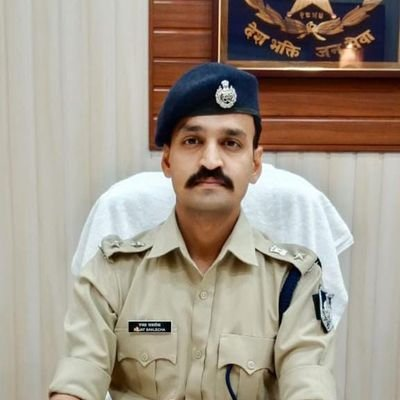

Not every IPS officer makes national headlines. Some do their most important work quietly — in districts most people cannot find on a map, dealing with problems that city-based policy conversations rarely address. Rajat Saklecha is that kind of officer.
A 2016-batch IPS officer from the Madhya Pradesh cadre, Saklecha is best known for transforming cybercrime response in Mandla — one of the state’s most remote and tribal-dominated districts — through a combination of institutional restructuring, grassroots awareness campaigns, and the kind of practical thinking that comes from having an engineering brain and a public servant’s sense of duty.
He did not get here in a straight line. His path involved a civil engineering degree, two unsuccessful UPSC attempts, a brief selection into a paramilitary service, and the patience to keep going until he got exactly the role he had wanted since childhood. That journey is worth understanding in full.
| Rajat Saklecha | |
|---|---|
|
|
|
| Wiki Facts & About Data | |
| Full Name: | Rajat Saklecha |
| Place of Birth: | Ratlam, Madhya Pradesh |
| Nationality: | Indian |
| Education: | Civil Engineering (2012); UPSC CSE 2015 |
Early Life and Background
Rajat Saklecha completed his early education in his hometown of Ratlam, a mid-sized city in western Madhya Pradesh known for its railway junction heritage and merchant community. Ratlam is not a place that produces many IPS officers — which is precisely what makes his story worth telling.
He studied at Kendriya Vidyalaya Ratlam — the central government school network that has, over decades, produced a remarkable number of civil servants across India. It is the kind of institution where reading newspapers is encouraged, where national identity is woven into the daily routine, and where the idea of serving the country through government is taken seriously.
He has written about his childhood habit of reading newspapers from an early age, noting that the desire to join civil services was always present — not because of parental pressure or financial anxiety, but out of genuine interest in public affairs and governance. That distinction matters. Many UPSC aspirants describe their preparation as a survival exercise. Saklecha’s motivation appears to have been something closer to vocation
Details about his parents are not part of the public record, which is common for serving IPS officers who maintain a degree of personal privacy. What is clear is that his family environment supported both academic discipline and independent thinking.
Education: From Civil Engineering to Civil Services
After completing his schooling — scoring over 80 per cent in Class XII — he pursued a degree in civil engineering, completing it in 2012 from Indore.
Civil engineering and public administration may seem like an unlikely pairing, but they share more than people assume. Both require systematic problem-solving, an understanding of how systems interact, and the ability to work with incomplete information under real-world constraints. In Saklecha’s case, his engineering background would later prove directly useful when he set about redesigning the cybercrime complaint infrastructure in Mandla — approaching institutional reform with the same logic he might apply to a structural problem.
The decision to move from engineering into civil services was not impulsive. After completing his degree, he moved to Delhi to prepare for the UPSC Civil Services Examination — a transition that thousands of engineers make every year, but that still requires considerable courage when you are walking away from a professional qualification.
The UPSC Journey: Three Attempts, One Goal
Rajat Saklecha’s UPSC journey is the kind of story that aspirants find genuinely useful — not because it was easy, but because it was honest.
In 2013, he attempted the UPSC CSE for the first time, making it through to the mains stage. In his second attempt in 2014, he reached the interview round and was also selected as Assistant Commandant in the CISF through a separate UPSC examination. For most people, a CISF appointment would be the conclusion of the story. He treated it as a waypoint
He has described his approach to the exam in characteristically unassuming terms, attributing much of his success to luck while acknowledging the importance of staying grounded. He was not someone who studied 12 to 15 hours daily. Instead, he remained his natural self — reading what interested him, thinking about governance, and avoiding the kind of anxiety-driven preparation that derails many talented candidates.
In his third attempt, UPSC CSE-2015, he successfully cleared the examination with an All India Rank of 141, securing the Indian Police Service. He was allotted his home cadre — Madhya Pradesh — which meant he would spend his career serving the state he grew up in.
First Postings: Gwalior and Ujjain
After completing training, Rajat Saklecha was among the IPS officers appointed as Assistant SP in Gwalior — one of Madhya Pradesh’s major cities, historically significant and administratively complex. Gwalior is the kind of posting that tests new officers quickly, given its mix of urban policing challenges, political sensitivity, and the demands of managing a large police district.
He then served as a trainee officer in Ujjain, another major MP city with its own unique challenges including high footfall from religious tourism and the logistical demands that come with it. These early postings gave him exposure to urban law enforcement across different contexts — experience that would inform his later approach to rural policing.
Rise Through the Ranks: Indore and Intelligence Work
Before his posting to Mandla, Saklecha served as the Deputy Commissioner of Police (DCP) for Intelligence and Security in Indore — the state’s commercial capital and its most populous city.
The intelligence and security role is not a standard law-and-order posting. It involves information gathering, threat assessment, and working with systems that operate largely outside public view. This background in analytical work clearly shaped his later approach to cybercrime — a domain that requires exactly the same kind of structured, information-led thinking.
Superintendent of Police, Mandla
Mandla is a district that many people in India’s urban centres would struggle to locate precisely on a map. It is a tribal-dominated district in Madhya Pradesh, where geographic remoteness and limited digital literacy create conditions that fraudsters have learned to exploit systematically.
When Rajat Saklecha took charge as Superintendent of Police in Mandla, he inherited a policing system that was not designed for the scale and nature of digital fraud that was affecting its residents. He set about changing it.
Transforming Cybercrime Response in Rural MP
Previously, cybercrime cases were handled by centralised offices at the district headquarters, requiring people from remote areas to travel long distances simply to file a complaint. Saklecha’s team implemented a solution: dedicated cyber desks in every police station across the district, staffed by constables and officers with engineering backgrounds who received specialised training in cybercrime
The logic was straightforward but the impact was significant. When filing a complaint requires a half-day journey, people do not file complaints. When it becomes a ten-minute walk to the local station, they do. More complaints mean more data, better detection, and ultimately more recoveries.
The results were measurable: while only 253 stolen mobile phones were recovered in 2023, that number jumped to 1,020 in 2024. Under his leadership, the district police recovered and refunded over Rs 60 lakh to victims of cyber fraud.
He also highlighted the specific challenge of SIM card misuse: “Fraudsters started making and misusing SIM cards registered in the names of villagers. People here are often tricked into such scams. We are focusing on prevention through awareness campaigns while also taking remedial measures.”
Complaint registration was also digitised entirely. Instead of paper-based recording, complaints are now entered directly into online portals, with 100 per cent online registration achieved across the district — enabling efficient case tracking and progress monitoring.
The Interstate Fraud Syndicate Case
The clearest illustration of what the reformed system was capable of came in December 2024.
Mandla police uncovered an interstate fraud syndicate that had been using WhatsApp groups to deceive people into investing in fake applications. The gang had defrauded victims of over Rs 7 crore across 16 states. What made the discovery remarkable was that it originated from a complaint filed at the Anjaniya village police outpost — one of Mandla’s most remote reporting points. A victim had been lured into online trading through a WhatsApp group and tricked into investing Rs 17 lakh from his father’s retirement savings into a fake trading application.
That a complaint from a remote village led to the unravelling of a fraud network spanning 16 states is precisely the kind of outcome that Saklecha’s infrastructure reforms were designed to enable. The village outpost did not escalate the complaint to headquarters — it handled it. And the system worked.
Road Safety Initiatives in Mandla
Cybercrime was not the only focus. Saklecha has also placed significant emphasis on reducing road accidents in the district, which has historically seen high casualty rates on its roads. This dual focus — on digital safety and physical road safety — reflects a policing philosophy that is responsive to the specific risks facing a particular community, rather than applying a generic template.
Mandla’s geography — forested areas, winding roads, limited highway infrastructure — makes road safety a genuine public concern. Addressing it alongside cybercrime prevention demonstrates that his team’s priorities are shaped by local needs, not just administrative fashion.
Leadership Style and Policing Philosophy
What distinguishes Rajat Saklecha’s approach is less about dramatic enforcement actions and more about institutional design. He did not transform Mandla’s cybercrime response by making more arrests. He did it by redesigning how complaints were received, who handled them, and how they were tracked.
His stated approach is clear: “Our aim is to minimise cybercrime in the district, and if it happens, we want to ensure a quick recovery of losses. If crimes are not reported, detection becomes difficult, and the chances of repetition increase.”
That philosophy — emphasising reporting, accessibility, and recovery rather than punishment alone — is a mature understanding of how policing actually reduces harm in practice. It suggests an officer who has thought seriously about what the job is for, not just how to perform it visibly.
His engineering background is also visible in how he approaches reform: identify the bottleneck, redesign the system, train the people, measure the result. It is the kind of thinking that does not always get credited in policing but makes a significant difference when applied well.
Current Posting: Commandant, 26th Battalion SAF, Guna
Following his tenure as SP Mandla, Rajat Saklecha was transferred and appointed as Commandant of the 26th Battalion, Special Armed Force (SAF), based in Guna, Madhya Pradesh.
The SAF commandant role is operationally very different from district SP work. It involves leading an armed battalion — a more structured, command-oriented responsibility compared to the district policing model. The transition reflects the natural career progression of an IPS officer moving through different functions within the service.
Personal Life
Rajat Saklecha maintains a deliberately private personal life, which is characteristic of many serving IPS officers who prefer to keep family matters away from public attention. Details about his wife and any children are not part of the verified public record, and this article will not speculate beyond what has been confirmed.
What is known is that he approaches his professional life with the kind of groundedness that tends to come from stable personal foundations. His public communication — in interviews, on social media, and in official statements — is measured, clear, and focused on work rather than personality projection.
Follow Rajat Saklecha on X (Twitter): @rajatsaklecha
Net Worth and Income
As a serving IPS officer of the 2016 batch, Rajat Saklecha’s income comes primarily from his government salary under the 7th Pay Commission structure applicable to Indian Police Service officers. At the Superintendent of Police or Commandant level, IPS officers receive pay in the senior pay scale bracket, along with applicable allowances.
His net worth has not been publicly disclosed and no verified figures are available. It would be inappropriate to speculate. Like most career civil servants, his financial profile reflects government service compensation — modest relative to the private sector, but accompanied by substantial non-monetary benefits including housing, security, and public influence.
Conclusion
Rajat Saklecha’s career is an argument for the value of patient, structural thinking in public service. He did not become an IPS officer on his first try. He did not make his name through dramatic raids or media-friendly operations. He made it by going to one of Madhya Pradesh’s most remote districts and methodically redesigning how its police force handles a category of crime that is growing faster than most institutions can respond to.
The jump from 253 mobile phone recoveries in 2023 to 1,020 in 2024 is not a statistic — it is a measure of how many ordinary people got their property back, had their complaints heard, and experienced a police force that was actually accessible to them. For a tribal-dominated rural district with limited infrastructure and high vulnerability to online fraud, that is meaningful progress.
His path from Kendriya Vidyalaya Ratlam to the UPSC examination hall to the forests of Mandla is the kind of career trajectory that does not make for dramatic television but does make a genuine difference in people’s lives. That, ultimately, is what public service is supposed to look like.
FAQs
1. Who is Rajat Saklecha IPS? Rajat Saklecha is a 2016-batch Indian Police Service officer from the Madhya Pradesh cadre. He secured All India Rank 141 in the UPSC Civil Services Examination 2015 and has served in various roles including Assistant SP Gwalior, DCP Intelligence and Security in Indore, Superintendent of Police Mandla, and most recently as Commandant of the 26th Battalion SAF in Guna.
2. What is Rajat Saklecha’s UPSC rank? He secured All India Rank 141 in the UPSC Civil Services Examination 2015, in his third attempt. He had previously cleared the UPSC mains in 2013 and reached the interview stage in 2014, also being selected as an Assistant Commandant in CISF during that attempt.
3. What did Rajat Saklecha achieve in Mandla? As Superintendent of Police in Mandla, Saklecha introduced cyber desks at every police station in the district, trained officers with engineering backgrounds in cybercrime handling, and digitised the complaint registration system. Under his leadership, stolen mobile phone recoveries jumped from 253 in 2023 to 1,020 in 2024, and over Rs 60 lakh was recovered and refunded to fraud victims.
4. What is Rajat Saklecha’s educational background? He completed his schooling at Kendriya Vidyalaya Ratlam and then earned a degree in civil engineering in 2012. He later relocated to Delhi to prepare for the UPSC Civil Services Examination, which he cleared in 2015.
5. What is Rajat Saklecha’s current posting? Following his tenure as Superintendent of Police in Mandla, Rajat Saklecha was transferred and appointed as Commandant of the 26th Battalion, Special Armed Force (SAF), based in Guna, Madhya Pradesh
Editorial Notice
The biography above is compiled from publicly available sources and is intended for general informational purposes only. At PeopleCabal, we are committed to accuracy — however, public records evolve, and some details may change over time. If you notice anything that requires a correction or update, we welcome you to reach out to us directly.
