
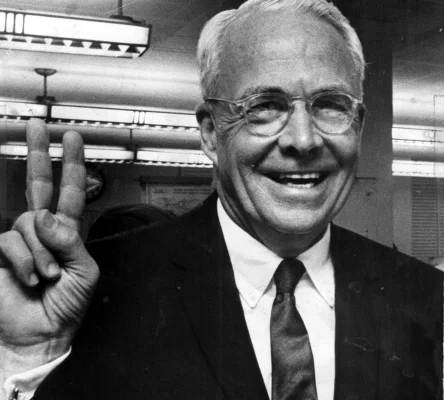

Ivan Allen Jr. served as Mayor of Atlanta from 1962 to 1970 and made a decision during his tenure that very few white Southern politicians of his era were willing to make: he testified before the United States Senate in 1963 in support of the Civil Rights Act — specifically the public accommodations section that would require integration of restaurants, hotels, and other businesses. He was, at the time, the only elected white official in the South to take that position publicly. It was an act of political courage that cost him significantly within his own community and that defined his place in the history of American civil rights as decisively as any single act a Southern mayor has ever performed.
Ivan Allen Jr. Biography
| Full Name | Ivan Earnest Allen Jr. |
|---|---|
| Date of Birth | March 15, 1911 |
| Nationality | American |
| Occupation | Businessman, Politician, Mayor of Atlanta |
| Education | Georgia Institute of Technology |
| Known For | Mayor of Atlanta 1962-1970; Civil Rights Act testimony; Atlanta’s transformation into a modern city |
Early Life and Business Background
Ivan Allen Jr. was born on March 15, 1911, in Atlanta, Georgia, into a prosperous business family. His father, Ivan Allen Sr., had built a successful office supply and equipment business — Ivan Allen Company — that was one of Atlanta’s established commercial enterprises. Growing up in this environment of business success and civic prominence gave Allen Jr. both the economic security that allowed him to take political risks and the understanding of Atlanta’s commercial class whose support would be essential to both his business and political careers.
He attended Georgia Institute of Technology, graduating in 1933 — a practical, technically oriented education appropriate for someone who would spend much of his career managing and building businesses. He joined his father’s company and built it into an even more successful enterprise, expanding its operations and its role in Atlanta’s commercial life. This business success gave him the financial independence and the civic standing that enabled his transition into politics.
His racial views in his early life were those of his class and region — he was not a civil rights activist who came to Atlanta’s mayoralty from a background of racial progressivism. He was a businessman from the Southern white establishment who encountered the reality of racial segregation in Atlanta, who came to understand its costs both moral and economic, and who made a series of increasingly consequential choices to move his city in a different direction. That arc — from conventional Southern white businessman to nationally recognized civil rights ally — is one of the more instructive conversion narratives in American political history.
The Mayoralty: Building a Modern Atlanta
Allen ran for mayor of Atlanta in 1961, defeating Lester Maddox — who would later become Georgia’s governor and would become a symbol of segregationist resistance — in a runoff election. His election was supported by Atlanta’s Black community, which saw him as significantly preferable to Maddox despite his imperfect civil rights record to that point.
As mayor, Allen pursued an ambitious agenda for Atlanta’s physical and economic development — he was instrumental in bringing Major League Baseball’s Braves to Atlanta, in developing the civic infrastructure that would eventually support Atlanta’s emergence as a major metropolitan center, and in the construction of facilities including Atlanta-Fulton County Stadium. His approach to economic development was forward-looking and ambitious, driven by the conviction that Atlanta’s future lay in integration into the national commercial mainstream rather than in the economic isolation that Southern resistance to civil rights was producing.
At the same time, he moved systematically to desegregate Atlanta’s public facilities and to work with Black community leaders rather than against them — a departure from the pattern of most Southern white political leadership of the era. He established communication with Martin Luther King Jr. and other Atlanta-based civil rights leaders, and when King was awarded the Nobel Peace Prize in 1964, Allen hosted the celebratory dinner in Atlanta — another act that was controversial within the white business community but that he judged essential to Atlanta’s aspirations as a national city.
The 1963 Senate Testimony
The single most consequential act of Allen’s public career was his testimony before the Senate Commerce Committee in 1963 in support of the public accommodations provisions of what would become the Civil Rights Act of 1964. He was the only elected white official from the South to testify in favor of the legislation — a fact that made his testimony enormously significant both politically and symbolically.
His argument was partly moral and partly practical: segregation was wrong as a matter of human dignity, and it was also economically damaging to Southern cities seeking to attract national business, conventions, and talent. The combination of moral argument and economic pragmatism was characteristic of Allen’s approach to political questions generally, and it was effective in communicating to audiences who might not have responded to moral argument alone.
The testimony brought him severe criticism from white Atlantans and white Southerners who viewed it as betrayal. It cost him politically within those communities. He was called a traitor and worse in the letters that poured into his office. He persisted, and Atlanta’s subsequent history — its emergence as the preeminent city of the New South, its role as the headquarters of global companies like Coca-Cola and Delta Air Lines, its hosting of the 1996 Summer Olympics — vindicates his judgment about where the city’s future lay.
The Aftermath of Martin Luther King Jr.’s Assassination
Allen was personally present on Auburn Avenue in Atlanta in April 1968 when the news of Martin Luther King Jr.’s assassination in Memphis reached the city. He went directly to Coretta Scott King to offer the city’s condolences and assistance — a gesture of personal respect and civic responsibility that was noted and appreciated by Atlanta’s Black community. His presence in those hours, and the dignity with which he represented the city in one of its most painful moments, was a final demonstration of the transformation his views and his leadership had undergone.
Legacy
Ivan Allen Jr.’s legacy is the city of Atlanta as it has become — a major American metropolitan center that managed the transition from segregation to integration with less violence and more economic momentum than almost any other Southern city, partly because its political leadership, at a critical moment, chose the right side. His testimony before the Senate in 1963 is the most visible expression of that choice, but the cumulative effect of eight years of mayoral leadership that consistently placed Atlanta’s future over the comfort of the status quo is the larger legacy.
Conclusion
Ivan Allen Jr. made the most important decision of his political life at a moment when making it required genuine courage — when his own community was telling him he was wrong, when the political costs were clear, and when the right choice was not the comfortable or the safe one. His example — of a Southern white businessman who encountered the injustice of racial segregation, who came to understand its costs both moral and economic, and who acted on that understanding — remains one of the more instructive and genuinely hopeful stories in the complex history of the American South’s encounter with its racial past.
Frequently Asked Questions
What is Ivan Allen Jr. most famous for?
Testifying before the US Senate in support of the Civil Rights Act of 1964 — as the only elected white Southern official to do so — and his two terms as Mayor of Atlanta from 1962 to 1970.
Who did Ivan Allen Jr. defeat to become mayor?
Lester Maddox, the segregationist who later became Georgia’s governor, in the 1961 Atlanta mayoral runoff.
What major sports franchise did Ivan Allen Jr. bring to Atlanta?
Major League Baseball’s Atlanta Braves, as part of his broader effort to build Atlanta’s national commercial profile.
Where did Ivan Allen Jr. study?
Georgia Institute of Technology, graduating in 1933.
What was Ivan Allen Jr.’s relationship with Martin Luther King Jr.?
He established communication with King and Atlanta civil rights leaders and hosted the dinner celebrating King’s Nobel Peace Prize in 1964 — a controversial but principled act of civic leadership.
Editorial Notice
The biography above is compiled from publicly available sources and is intended for general informational purposes only. At PeopleCabal, we are committed to accuracy — however, public records evolve, and some details may change over time. If you notice anything that requires a correction or update, we welcome you to reach out to us directly.
