
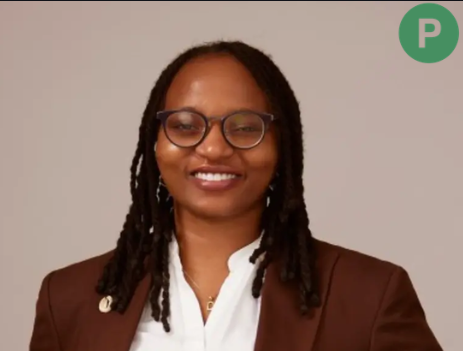

There is a particular kind of journalism that does not just report on a problem — it makes you feel it. The kind where a single photograph of a burned fisherman on a Gambian boat carries more weight than a thousand-word dispatch. The kind where the camera does not observe from a distance but sits inside the story, close enough to see the texture of someone’s grief or their quiet defiance. That is the journalism Grace Ekpu practises — and it is the reason she has gone from a self-taught photographer in Lagos to an investigative reporter at the Associated Press’s Global Investigations Unit, with her byline and photographs appearing in the New York Times, the Seattle Times, Yahoo News, and publications across four continents.
What makes her story particularly compelling is that almost none of it was planned. She did not set out to become a photographer. She discovered it, fell in love with it, pursued it alongside a journalism career, and eventually fused both into a professional identity that is genuinely difficult to categorise — and genuinely difficult to find anywhere else in Nigerian media.
| Grace Ekpu | |
|---|---|
|
|
|
| Wiki Facts & About Data | |
| Full Name: | Grace Ekpu |
| State of Origin: | Lagos State |
| Nationality: | Nigerian |
| Occupation: | Documentary photographer, filmmaker, investigative journalist, broadcast journalist |
| Relationship: | Not publicly confirmed |
| Education: | Babcock University Nigeria (B.A. Mass Communication, First Class); University of Glasgow, UK (M.A. Media Management) |
| Social / Web: | 🌐 Website |
Early Life and Background
Grace Ekpu is a self-taught documentary photographer and filmmaker born in Nigeria. She is based in Lagos and has spent her career covering West Africa and beyond, but the specific details of her date of birth, state of origin, and early family background have not been publicly confirmed — a privacy choice that is consistent with her general preference for letting her work speak on her behalf rather than her biography.
What is known from her interviews is that photography entered her life before journalism did. Even before she became a journalist, she was already a photographer. That detail is significant. For most media personalities in Nigeria, photography is a tool that journalism training introduces. For Grace, the sequence was reversed — she came to journalism already seeing the world through a photographer’s eye, looking for frames, looking for the moment within the moment that tells the whole story in a single image. Audible
Her first discipline was street photography — the most democratic and the most demanding form of the art, requiring no subject consent, no commission, no assignment. Just a person with a camera and the patience to be in the right place at the right moment and the judgment to know when that moment has arrived.
She usually approaches stories from a place of authenticity — not interested in documenting something because she thinks it can change her life and story, but genuinely interested, and this comes across to the people she is documenting. They feel comfortable sharing their stories because of this genuine connection. People want to talk, but they need to trust that you are the right person to share their personal information with.
That philosophy of approach — authentic curiosity over career calculation — is the foundation of everything she has built professionally. It is also the thing that makes her photographs different from those of many of her contemporaries. You can feel, looking at her images, that the subjects chose to be seen.
Education
She holds a BA in Mass Communication with First Class honours from Babcock University Nigeria and an MA in Media Management from the University of Glasgow
Babcock University, located in Ilishan-Remo, Ogun State, is one of Nigeria’s most respected private universities. Graduating with First Class honours in Mass Communication requires a combination of academic discipline, practical understanding of media systems, and consistently strong performance across journalism, broadcasting, public relations, and communication theory. For Grace, it confirmed what her photography already suggested — that she was not just talented but rigorous.
The University of Glasgow’s MA in Media Management added an international business and strategic lens to her storytelling skills. Media management covers the economics of media organisations, digital strategy, audience analysis, and the business structures that determine how journalism is funded, distributed, and sustained. For a journalist who would eventually work at TVC News, the BBC, and the Associated Press — three very different organisations in terms of funding model and editorial structure — that strategic understanding has been genuinely useful.
What is notable about Grace’s educational path is that it combines formal journalism training with formal media business training — a combination that most working journalists have one half of but rarely both. It gives her the ability to understand not just how to tell stories but how and why those stories reach the audiences they do.
Career Journey
TVC News Africa: The Foundation
She began her career as a news producer in 2013. Her media career started off when she joined TVC News Africa as a News Producer
TVC News Africa is one of Nigeria’s most professionally run television news operations. Working as a producer there — rather than as an on-screen journalist — gave Grace something that would prove invaluable for her later career: a behind-the-camera understanding of how broadcast news is made. She learned how stories are commissioned, how packages are structured, how editorial decisions are made under deadline pressure, and how the gap between what a journalist experiences in the field and what ultimately reaches the viewer is navigated. That production sensibility now informs every visual story she creates.
The Photography Parallel: Teaching Herself While Working
Even as she built her journalism career, Grace was simultaneously developing a parallel practice in documentary photography — largely on her own time and largely without formal instruction.
Her desire to specialise in documentary photography saw her turn to freelance photography in 2015 while working on personal projects and assignments throughout West Africa.
Freelance documentary photography in West Africa in 2015 was not a comfortable or well-remunerated path. It required investing in equipment, building a portfolio without a commissioning editor’s budget, pitching stories to international publications that were unlikely to have heard of you, and accepting that most of the work done in the early years would not be published anywhere. Grace did all of that while maintaining a journalism career — a level of dual-track professional commitment that is genuinely unusual.
In March 2019, the photographer Chimodu told her she was one of the Nigerian photographers — if not the only one — with an approach to photography that he liked. He emphasised the importance of the work creatives do and how that is all they have and will be remembered by. He died in 2022, and she still thinks about his advice because his work is all that remains now: the great portraits he made of hip-hop rappers
That tribute — to a photographer who recognised her before the international press did — is one of the most revealing moments in Grace’s public statements about her work. It confirms that her early validation came not from institutions or awards but from peers who understood what she was doing and why it mattered.
BBC Africa: Senior Journalist and Commission Editor
She later joined the BBC in 2017–2022, where she was a Senior Journalist, planning and commissioning stories across Anglophone West Africa.
The BBC’s West Africa bureau is one of the most significant English-language journalism operations on the continent. As a Senior Journalist there, Grace was not just filing her own stories — she was shaping what the BBC covered across an entire region. Commissioning stories means deciding which issues get investigated, which voices get heard, which crises receive sustained attention rather than a single dispatch. That editorial power, exercised over five years at one of the world’s most credible journalism institutions, placed her in a position of significant influence over how West Africa was understood by BBC’s global audience.
Her photography work at the BBC included some of her most widely recognised pieces. She was commissioned by the New York Times in 2018 to document the This Is 18 project in Lagos — a commission that placed her work in one of the world’s most prestigious journalism platforms.
In 2018, her work The Passing of Time was exhibited at the Lagos Photo Festival — one of Africa’s most significant photography exhibitions, held annually in Lagos and attracting international curators, editors, and collectors. Having work shown there, while simultaneously working as a BBC Senior Journalist, confirmed that she had successfully built two parallel professional identities of real substance.
In 2019, she was nominated for the annual Canon Storytelling Master Class in Nigeria, received a scholarship to attend the annual Foundry Photojournalism Workshop in Kigali, Rwanda, and in 2020 was nominated for the Joop Swart Masterclass at World Press Photo — one of the most prestigious photojournalism mentorship programmes in the world. A nomination there is itself a recognition of serious professional standing.
VII Photo Mentee: World-Class Mentorship
The mentorship with VII helped her to connect with other amazing documentary photographers who are her friends still today. Industry professionals like Ashley Gilbertson, Gary Knight, and Maggie Steber mentored them and gave advice during the mentorship. Mentees received representation and a mini grant to work on a project in their communities in 2022
VII Photo Agency is one of the most respected photojournalism collectives in the world — its members have covered virtually every major global conflict and humanitarian crisis of the past four decades. Being selected as a VII mentee between 2021 and 2023 placed Grace in direct professional contact with photographers whose work she had likely studied as part of her self-education. It also gave her representation — access to the editorial networks and commissioning relationships that are essential for international photojournalism careers.
Associated Press Global Investigations: The Current Chapter
She moved to the Associated Press’ Global Investigations
The Associated Press’s Global Investigations Unit is the wire service’s most ambitious editorial team — producing the kind of deep, multi-platform investigations that take months to complete, cross international boundaries, and have real-world consequences in terms of policy change and accountability. Being part of that unit as a reporter and visual journalist is a significant professional position by any international standard.
Her focus at the AP has been on the crisis of illegal fishing in West African waters — an issue that is simultaneously an environmental catastrophe, an economic injustice, a human rights crisis, and a story of geopolitical power dynamics playing out at sea. Her investigations have documented fishermen injured in arson attacks on foreign-owned vessels, the collapse of traditional fishing economies in Gambia and Senegal, and the “sea war” pitting local artisanal fishermen against foreign trawlers as overfishing and global seafood demand strain dwindling fish stocks
These are not comfortable stories to report. They require working in coastal communities where there are competing interests — fishing companies, governments, foreign trawlers — each of which has reason to discourage scrutiny. Grace’s ability to gain trust in those communities, documented in dozens of photographs published by the AP to newspapers across the United States, Europe, and beyond, reflects the same approach she described from her earliest photography work: authenticity, patience, and genuine curiosity.
Awards and Recognition
Grace is a member of African Women Photographers and a member and recipient of the Black Women Photographers 2024 grant. The BWP grant is awarded to Black women photographers working on projects of social significance — receiving it confirmed that her feature documentary project was considered worthy of investment by one of the field’s most important support organisations.
She was the winner of the Fashola Photography Competition in 2018 and participated in the inaugural GT Bank Days of Dorcas female photographer’s workshop. Her work has been exhibited at the Lagos Photo Festival and at the 25th Bamako Encounters, one of Africa’s most significant photography biennales
She has covered assignments for Plan International, Action Aid, and the British Red Cross — international NGOs whose storytelling commissions go to photographers with demonstrated ability to represent vulnerable communities with accuracy and dignity.
Influence and Philosophy
Grace is currently focusing on an observational documentary that explores themes around healthcare disparities and access issues. She believes in using visual storytelling for social change.
Her philosophy of documentary work is articulated clearly in her own words: “Your voice matters, and do not forget the first thing that made you pick up a camera.” That instruction — to remember the original impulse — is a reminder she has given herself as much as others. She picked up the camera to tell stories that were not being told. Sixteen years later, she is still doing exactly that, now with the resources and platform of one of the world’s largest news organisations behind her.
She also consistently advocates for telling the African story from an African perspective — not the crisis-and-conflict framing that external media imposes, but the full, complex, textured reality of lives lived on the continent in all their ordinariness and exceptionalism.
Personal Life
Grace Ekpu keeps her personal life private. Her age, state of origin, romantic status, and family details have not been publicly confirmed. She identifies publicly as a journalist, photographer, and filmmaker — and those professional identities are the ones she has chosen to make visible.
Net Worth
Grace Ekpu’s net worth has not been publicly confirmed. Her income streams span broadcast journalism at TVC News and the BBC, investigative reporting at the Associated Press, photography commissions from the New York Times and international publications, NGO assignments, grant funding from organisations including Black Women Photographers, and exhibition fees. Given the seniority of her current AP role and the breadth of her commissioning relationships, she is financially stable — but no specific figure has been publicly verified.
Conclusion
Grace Ekpu is one of the most internationally recognised Nigerian journalists and photographers of her generation — not because she sought celebrity, but because the work she does is genuinely excellent and genuinely necessary. Her photographs of West African fishing communities, her BBC journalism from across Anglophone West Africa, and her AP investigations into ocean crime are contributions to the historical record of a continent that is too often seen but rarely truly documented.
She is, in the truest sense of the word she uses to describe herself on Instagram — a camerassassin. Precise, patient, purposeful. Each frame is a choice. Each story is a commitment. And her career, still building, already represents one of the most significant bodies of documentary work produced by a Nigerian visual journalist in the past decade.
Frequently Asked Questions (FAQs)
Who is Grace Ekpu? She is a Nigerian documentary photographer, filmmaker, and investigative journalist. She currently works as a reporter at the Associated Press’s Global Investigations Unit, covering oceans and fisheries in West Africa. She previously spent five years as a BBC Africa Senior Journalist.
Where did Grace Ekpu go to school? She holds a First Class B.A. in Mass Communication from Babcock University, Nigeria, and an M.A. in Media Management from the University of Glasgow, United Kingdom.
What is Grace Ekpu working on currently? As of 2025, she is reporting on the illegal fishing crisis in West African waters for the Associated Press, with investigations published in major US and international newspapers. She is also developing an observational documentary exploring healthcare disparities and access in Nigeria.
What awards has Grace Ekpu won? She is a recipient of the Black Women Photographers 2024 grant, winner of the Fashola Photography Competition 2018, a winner of the GT Bank Days of Dorcas Photography Workshop 2018, a 2021–2023 mentee of the VII Photo Agency, and a nominee for the World Press Photo Joop Swart Masterclass in 2020.
Is Grace Ekpu self-taught in photography? Yes — she describes herself as a self-taught documentary photographer. She came to photography before her formal journalism career and developed her visual practice through personal projects, workshops, mentorships, and international assignments rather than through a formal photography degree.
Is Grace Ekpu married? Her marital status and personal life details have not been publicly confirmed. She maintains a deliberate boundary between her professional public identity and her personal life.
Editorial Notice
The biography above is compiled from publicly available sources and is intended for general informational purposes only. At PeopleCabal, we are committed to accuracy — however, public records evolve, and some details may change over time. If you notice anything that requires a correction or update, we welcome you to reach out to us directly.
