
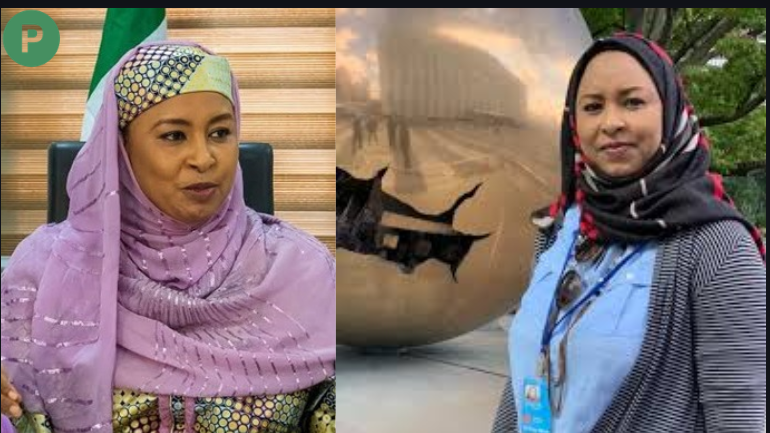

Not every influential figure in Nigerian public life arrives with fanfare. Some build their credibility slowly, across decades of professional service, until an appointment comes along that puts everything into context. Hajia Halima Shehu is one of those figures. A woman who moved through banking, politics, and development work before landing one of Nigeria’s most consequential social welfare roles, her story is less about sudden stardom and more about the kind of steady, unglamorous work that actually moves institutions.
When the Nigerian Senate confirmed her as National Coordinator of the National Social Investment Programme Agency (NSIPA) in October 2023, it was the culmination of a career built across multiple sectors — and a signal that her particular combination of financial expertise and policy understanding was exactly what that agency needed at that moment.
Who Is Halima Shehu?
Hajia Halima Shehu is a Nigerian public servant, former banker, and politician whose career reflects a deliberate journey through some of the most technically demanding areas of Nigerian professional life. She comes from Kafin Dagi village in Katsina State — a state in Nigeria’s northwest that has produced several significant national figures — and she has spent the better part of three decades accumulating expertise across finance, governance, and social development.
Her confirmation as NSIPA National Coordinator placed her at the helm of an agency responsible for managing federal social investment programmes designed to reach millions of Nigeria’s most economically vulnerable citizens. That is not a ceremonial role. It demands financial discipline, institutional management, and the ability to translate federal policy into community-level impact — all areas where her background is directly relevant.
Halima Shehu Biography
| Detail | Information |
|---|---|
| Full Name | Hajia Halima Shehu |
| Age | 53 years old (born 1973) |
| Nationality | Nigerian |
| State of Origin | Katsina State |
| Hometown | Kafin Dagi Village, Katsina |
| Profession | Public Servant, Politician, Former Banker |
| Current Role | National Coordinator, NSIPA |
| Political Party | Not publicly confirmed |
| Education | BA English, MA International Affairs & Diplomacy — ABU Zaria |
| Religion | Islam |
| @sadeeya_yarima |
Early Life
Halima Shehu was born in 1973 in Kafin Dagi, a village in Katsina State. Growing up in northwest Nigeria during the 1970s and 1980s meant navigating a country in constant flux — military governments, structural adjustment pressures, and a society working out what education and opportunity meant for women in largely conservative communities.
That she pursued academic excellence through this period, and continued through to postgraduate study, says something meaningful about both her personal drive and the environment that shaped her. Katsina, despite its conservative reputation in some circles, has a long tradition of scholarship and intellectual pursuit, and families that invested in their daughters’ education were not without precedent.
Her early years in Kafin Dagi gave her a grounding in community life that would later inform her approach to social development work. You cannot design effective social investment programmes from a purely theoretical position — you need to understand what scarcity and need actually look like at the village level. Halima Shehu grew up with that understanding embedded in her perspective.
Ethnicity, Tribe, and Cultural Background
Halima Shehu is Hausa-Fulani, the dominant ethnic group in Katsina State and across much of northern Nigeria. This cultural identity carries specific social expectations — around family, faith, dress, and public conduct — that have shaped how she presents herself professionally.
She operates within an Islamic cultural framework, which is reflected in her title “Hajia,” indicating she has completed the Hajj pilgrimage to Mecca. In northern Nigerian professional and political contexts, this title carries social weight beyond its religious meaning — it signals standing, maturity, and a certain kind of rootedness in community values.
Her ethnic and cultural background has been an asset rather than a limitation. Being from Katsina and understanding the northwest’s dynamics from the inside has made her a credible interlocutor in federal policy spaces where northern Nigeria’s development challenges are regularly on the agenda.
Education: From Katsina to Zaria
Halima Shehu’s educational journey is worth tracing in some detail, because it reflects the kind of deliberate, progressive investment in knowledge that serious careers are built on.
She began at Ambuttai Primary School (now Musa Yar’adua Primary School) in Katsina, where she completed her First School Leaving Certificate. Her secondary education took her to the Federal Government College, Kaduna — a federal unity school designed to bring together students from across Nigeria’s states, exposing her early to a broader national perspective than her hometown alone could offer. She completed her West African Examination Certificate there.
For her undergraduate studies, she attended Ahmadu Bello University (ABU), Zaria — one of Nigeria’s oldest and most prestigious universities — where she earned a Bachelor of Arts in English Language. The choice of English Language as a discipline is often underestimated: it develops precision in communication, analytical reading, and the ability to construct and deconstruct arguments — skills that translate directly into policy work, diplomacy, and institutional leadership.
She later returned to ABU for a Master’s degree in International Affairs and Diplomacy, a postgraduate qualification that gave her formal grounding in global governance frameworks, international institutions, and the political economy of development.
Beyond formal degrees, she invested continuously in professional training — completing programmes in banking operations, customer service, compliance, auditing, and financial technology. This combination of liberal arts education, diplomatic studies, and technical banking training produced a professional profile that is genuinely unusual and difficult to replicate.
Banking Career: Learning the Language of Money
Before she became known as a public servant or political figure, Halima Shehu built a substantial career in the Nigerian banking sector. Banking in Nigeria is not a gentle introduction to professional life — it is one of the country’s most competitive, technically demanding, and high-pressure environments.
Her training in banking operations, compliance, auditing, and financial technology indicates that she worked across multiple functional areas of the industry. Compliance and auditing, in particular, require a specific kind of professional integrity: you are the person whose job it is to ensure that rules are followed even when it is inconvenient, that financial records are accurate even when they reflect badly, and that institutional risks are flagged even when leadership would prefer silence.
These are not easy roles. They require both technical competence and personal courage. The fact that Shehu built her career in this environment — and apparently thrived — shaped her into the kind of administrator who understands financial accountability from the inside, not just from policy documents.
Her banking career gave her something that many Nigerian politicians and public servants lack: a genuine understanding of how money moves, where it can be mismanaged, and how to build systems that prevent that from happening.
Entry into Politics and Public Service
The transition from banking to public life is not uncommon among Nigerian professionals who reach a certain level of expertise and begin to feel that their skills could serve a broader purpose. For Halima Shehu, the move into politics and public service represented an evolution rather than a departure.
Her background in Katsina — a politically significant state that has produced federal-level figures including a former Nigerian president — meant she was operating in an environment where the connections between community, party, and government are densely woven. Building a profile there, as a woman with strong educational credentials and professional standing, required navigating those connections with skill.
Her specific political party affiliation has not been widely confirmed in publicly available records, and responsible reporting requires noting that gap rather than filling it with speculation. What is clear is that she developed sufficient political trust and institutional credibility to be nominated and confirmed for one of the more demanding senior positions in Nigeria’s social welfare architecture.
Appointment as NSIPA National Coordinator
In October 2023, the Nigerian Senate confirmed Halima Shehu as National Coordinator of the National Social Investment Programme Agency (NSIPA). This confirmation was a significant moment — not just for her personally, but for the agency, which had gone through considerable turbulence in its earlier years.
Senate confirmation in Nigeria is not automatic. Nominees face scrutiny, and their professional records are examined. The fact that she passed through that process successfully reflects the credibility she had accumulated across her career. Her mixed background — finance, diplomacy, public administration — positioned her as someone who could manage the agency’s operational complexity while also interfacing with international development partners and federal oversight structures.
What NSIPA Does and Why It Matters
To understand why Halima Shehu’s role matters, it helps to understand what NSIPA actually does. The National Social Investment Programme Agency is the federal body responsible for managing Nigeria’s social safety net programmes — initiatives designed to support the country’s most economically vulnerable populations.
These include school feeding programmes, conditional cash transfer schemes, and employment support initiatives. When these programmes work well, they change material conditions for millions of Nigerians at the bottom of the income distribution. When they are poorly managed, the money disappears into administrative waste and the people who were meant to benefit receive nothing.
Managing NSIPA effectively requires someone who understands financial systems well enough to prevent leakage, understands governance well enough to manage institutional relationships, and understands community-level realities well enough to assess whether programmes are actually reaching their targets. Shehu’s career arc speaks directly to all three of those requirements.
Leadership Style and Public Service Philosophy
From what is publicly observable about Halima Shehu’s career, her leadership style leans toward the technical and institutional rather than the performative. She is not, from available evidence, a political figure who prioritizes media presence and personal branding. Her profile has been built on professional credibility rather than public spectacle.
This approach has its advantages in roles like the NSIPA coordinatorship, where the actual work — building systems, enforcing accountability, managing programme delivery — requires sustained attention rather than constant public positioning. Nigeria’s social investment space has suffered historically from high-visibility leadership that produced low-impact results. A technically grounded administrator focused on outcomes rather than optics is exactly what the sector has needed.
Her background in compliance and auditing also suggests an orientation toward procedural accountability — ensuring that processes are followed, that funds are tracked, and that deviation from standards is documented and addressed. In a federal agency managing billions in social investment funds, that instinct matters enormously.
Religion and Personal Values
Halima Shehu is Muslim, and her faith is clearly central to her public identity. The title “Hajia” signals both religious observance and community standing. In northern Nigerian professional and political culture, faith and work are not compartmentalized — they inform each other, and a person’s religious integrity is often read as an indicator of their professional character.
There is no public record of controversy around her personal conduct or values, which, in Nigeria’s often turbulent public life, is itself a form of testimony.
Personal Life: Family and Private World
Halima Shehu has maintained a relatively private personal life, which is somewhat unusual for a figure of her public standing. Details about her husband or spouse have not been confirmed in publicly available, verified sources, and her family background — beyond her origins in Kafin Dagi, Katsina — has not been extensively documented in the public record.
What can be said is that she comes from a community and a cultural tradition in which family is central, and her professional achievements were almost certainly shaped in part by the support structures around her. Women who reach senior federal positions in Nigeria rarely do so without a network of family and community backing that makes the journey possible.
Her parents raised her in an environment that valued education and public service — that much is legible from the choices she made throughout her life, even if the specific details of her family remain private.
Net Worth and Financial Profile
Halima Shehu’s net worth has not been publicly confirmed by any credible financial source. Her income throughout her career has derived primarily from her banking profession, followed by her public sector roles in the Nigerian federal government.
Senior federal positions in Nigeria carry structured government salaries, which are matters of public record through the Revenue Mobilization Allocation and Fiscal Commission’s published scales. They are not, by any standard, wealth-generating positions — public servants at this level live comfortably but are not in the same financial category as Nigeria’s private sector elite.
Any specific figure attributed to her online without verified sourcing should be treated with appropriate skepticism.
Social Media Presence
Halima Shehu maintains an Instagram presence under the handle @sadeeya_yarima, where she shares aspects of her personal and professional life. For those interested in following her work and activities directly, this is the verified channel for doing so.
As is appropriate for a senior public servant, her social media engagement reflects her public role rather than functioning as a personal platform for political commentary.
Legacy in Progress
It would be premature to write a final accounting of Halima Shehu’s legacy — she is 53 years old, actively serving in a senior federal role, and her most consequential work may well still be ahead of her. What can be said now is that her career represents a model that Nigerian professional life does not always celebrate: the long game.
She did not arrive at federal prominence through a single dramatic moment or a powerful patron’s sudden favour. She built a foundation — primary school in Katsina, secondary school in Kaduna, undergraduate and postgraduate degrees in Zaria, a career in banking, professional certifications in compliance and auditing, and then, gradually, a transition into public service. Each step prepared her for the next.
If her tenure at NSIPA succeeds in improving the delivery and accountability of Nigeria’s social investment programmes, the beneficiaries will likely never know her name. That is, in many ways, exactly how effective institutional leadership works — and exactly the kind of impact that is worth measuring.
Conclusion
Hajia Halima Shehu’s career is a study in professional intentionality. From Kafin Dagi village to the halls of Ahmadu Bello University, from banking compliance departments to a Senate-confirmed federal appointment, she has moved through Nigerian professional life with a consistency of purpose that is genuinely rare. Her role at NSIPA puts her in a position to affect the lives of millions of Nigerians who sit at the economic margins — and her background suggests she understands, at a practical level, what that responsibility actually demands. At 53, she is not a figure whose story has been written. She is one still writing it.
Frequently Asked Questions (FAQs)
1. What is Halima Shehu’s current role in the Nigerian government? Halima Shehu serves as the National Coordinator of the National Social Investment Programme Agency (NSIPA), a position she was confirmed into by the Nigerian Senate in October 2023.
2. Where is Halima Shehu from? She is from Kafin Dagi village in Katsina State, in northwest Nigeria. She is of Hausa-Fulani ethnicity.
3. Where did Halima Shehu study? She attended Ambuttai Primary School in Katsina, Federal Government College in Kaduna, and then Ahmadu Bello University (ABU) in Zaria, where she earned both her Bachelor of Arts in English Language and her Master’s degree in International Affairs and Diplomacy.
4. What is Halima Shehu’s professional background? Before entering public service, she had a substantial career in the Nigerian banking sector, with professional training in banking operations, compliance, auditing, customer service, and financial technology.
5. How old is Halima Shehu? Halima Shehu was born in 1973, making her 53 years old as of 2026.
Editorial Notice
The biography above is compiled from publicly available sources and is intended for general informational purposes only. At PeopleCabal, we are committed to accuracy — however, public records evolve, and some details may change over time. If you notice anything that requires a correction or update, we welcome you to reach out to us directly.
