
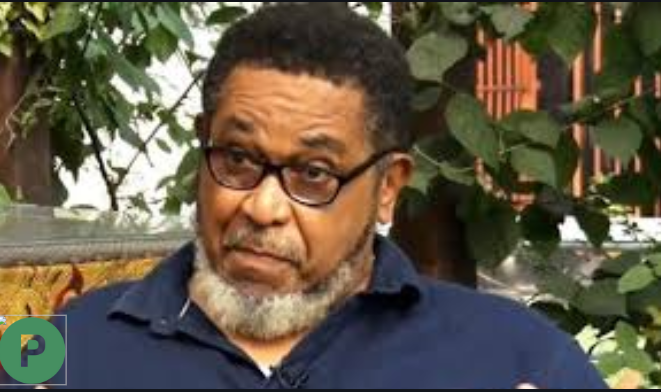
Patrick Doyle Biography: The Voice That Shaped Nigerian Broadcasting and Nollywood

Some careers are built on momentum. Others are built on conviction. Patrick Rupherford Doyle belongs firmly in the second category. For more than four decades, he has navigated Nigerian broadcasting and acting not with the frantic energy of someone chasing relevance, but with the composed authority of a man who understood his craft early and has never stopped refining it.
Born on the 23rd of March, 1961, Doyle entered Nigeria’s entertainment and media landscape at a time when both industries were still finding their shape. He was there before Nollywood had a name. He was on air when Nigerian television was still learning what it could be. And through it all — the industry’s highs and lows, personal tragedies, and the relentless pace of a changing media world — he has remained a figure of genuine substance.
That is not a common thing. In a space that often rewards loudness, Patrick Doyle’s longevity comes from something quieter: credibility.
| Patrick Rupherford Doyle | |
|---|---|
 Patrick Doyle Biography: The Voice That Shaped Nigerian Broadcasting and Nollywood: History · Bio · Photo
|
|
| Wiki Facts & About Data | |
| Full Name: | Patrick Rupherford Doyle |
| Date of Birth: | March 23, 1961 |
| Age: | 64 years old (as of 2025) |
| State of Origin: | Delta State |
| Nationality: | Nigerian |
| Occupation: | Actor, Broadcaster, Producer |
| Tribe: | Itsekiri and Efik descent |
| Children: | 5 |
| Education: | Saint Finbarr’s College, Akoka; Federal Radio Corporation of Nigeria |
| Social / Web: | 📸 @patrickdoylemedia |
Early Life and Background
Patrick Doyle is a Delta State indigene — a son of the Niger Delta’s cultural mix, with roots in both the Itsekiri and Efik peoples. These are two distinct and historically significant ethnic groups in southern Nigeria, each with strong traditions of trade, oral culture, and community leadership. Growing up between these identities likely gave Doyle a particular sensitivity to language, tone, and presence — qualities that would later define both his broadcasting voice and his acting style.
Though his origins are in Delta State, Doyle grew up in Lagos, Nigeria, while maintaining his roots in Delta State. Lagos, particularly in the 1960s and 70s, was a city in rapid transformation — a place where ambition had room to move and where media, culture, and commerce were all in conversation with each other. For a young man with an ear for language and an instinct for performance, it was a formative environment
Details about his father and early family life have not been widely shared in public forums, which is consistent with Doyle’s general preference for keeping certain personal territories private — a boundary he has maintained even as his public profile has grown.
What is visible is the trajectory: a boy from Delta State, raised in Lagos, who found his calling not in law or commerce (common ambitions for educated young Nigerians of his generation), but in the art of communication through sound and screen.
Education: Where the Voice Got Its Training
Doyle attended Saint Finbarr’s College, Akoka — one of Lagos’s more respected secondary institutions, a school with a tradition of producing students who go on to lead in various fields. It was there that the foundations of his intellectual and communicative discipline were likely laid.
After secondary school, he furthered his studies at the Federal Radio Corporation of Nigeria — a logical next step for a young man who had already identified broadcasting as his vocation. Training within an institutional broadcasting environment gave Doyle something that pure talent alone cannot: technical grounding. He learned not just how to speak, but how broadcasting works as a system — production, presentation, programming, and the relationship between content and audience.
That combination of formal secondary education and vocational media training would prove to be the foundation of a remarkably durable career.
Career Journey
The Broadcasting Years: Starting at 20
Doyle began his career in broadcasting at age 20, working with the Voice of Nigeria and the Nigerian Television Authority (NTA), where he honed his skills as a presenter and producer. Starting at the Voice of Nigeria was significant. VON, as a national broadcaster with both domestic and international reach, demanded a particular kind of professionalism — polished delivery, discipline, and the ability to communicate credibly across audiences. Doyle thrived in that environment.
His work at NTA further expanded his television instincts. Between radio and television, he was building a media literacy that few of his contemporaries could match — the ability to command attention in both audio and visual formats, which are more different from each other than they first appear.
Pioneering Talk Television
One of Doyle’s less-discussed but genuinely significant contributions to Nigerian media is his role in shaping entertainment television programming. He pioneered entertainment talk shows in Nigeria with Friday Nite Live — a programme that predated the genre’s widespread adoption in the country. Hosting what is considered Nigeria’s first late-night entertainment show required not just charisma but editorial courage: choosing guests, navigating conversations, holding an audience without a script to hide behind.
Some of his other notable shows include Real Estate This Week and Morning Ride. These were not glamorous productions, but they were substantive ones — the kind of programming that informs and engages rather than simply entertains. Doyle’s willingness to work across genres reflected a broadcasting philosophy rooted in public value rather than personal brand.
He later served as a consultant for Silverbird TV and earned the Best TV Presenter award at the inaugural THEMA awards. The THEMA recognition was more than a trophy; it was an industry acknowledgement that his peers and professionals in Nigerian media considered him among the very best at his craft
Entering Nollywood: The Pastor Who Became a Fixture
When Doyle moved into acting, he did not arrive as a celebrity trying his hand at films. He arrived as a broadcaster with deep screen experience and the kind of commanding voice that Nollywood’s early producers quickly recognised as an asset.
His breakthrough came through portrayals of pastors and religious figures in the burgeoning video film era, where he became a staple for depicting moral authority and spiritual guidance in popular narratives. The 1990s were Nollywood’s foundational decade — a period of extraordinary volume and energy, when Nigerian home video was exploding onto the scene and reaching audiences across Africa and the diaspora. Doyle’s authoritative presence made him a reliable anchor in films that needed gravitas.
Among his early standout roles was that of the pastor in Witches (1998), a horror-drama directed by Teco Benson that explored supernatural themes. It was the kind of role that could have trapped a lesser actor in typecasting. But Doyle used it as a launching pad rather than a ceiling.
The Modern Era: Evolving With the Industry
What distinguishes Doyle from many of his generation is that he has moved with the industry rather than being left behind by it. His credits include acclaimed works such as The Widow (2005, which he also produced), Sons of the Caliphate (2016), Castle & Castle (2018), Isoken, and The Black Book. These are not nostalgia projects. Sons of the Caliphate and Castle & Castle, in particular, represent the new wave of high-production-value Nigerian television — the streaming era content that is reaching global audiences on platforms like Netflix.
In an industry that often sidelines older talent in favour of youth, Doyle’s continued presence in marquee productions is a statement. Directors and producers keep casting him because he delivers. Consistently.
He also lent his voice to the character of Udume Bozimo in Lady Buckit and the Motley Mopsters (2020), Nigeria’s first feature-length animated film. Stepping into animation — a completely new format — at nearly 60 years old reflects a curiosity and adaptability that defines the best media professionals
Writing, Producing, and the Idea of a Real Film Industry
Doyle’s relationship with Nigerian cinema is not simply that of a performer. He has written and produced TV soaps like Jaded Options, which earned him widespread acclaim. And his views on the industry are worth paying attention to. He has argued publicly that Nigeria does not yet have a true film industry — that what exists is closer to a video trade, lacking the systematic production infrastructure that defines genuine cinematic culture. Coming from someone who has been inside that industry for decades, it is a critique that deserves serious consideration rather than dismissal
Influence and Legacy: Broadcasting as a Calling, Not a Career
He is a household name in the entertainment industry, but he has always said broadcasting remains his biggest passion. That is a meaningful distinction. In an era when acting tends to carry more celebrity currency than broadcasting, Doyle’s refusal to pretend otherwise speaks to his authenticity
While Patrick Doyle values recognition, he maintains a measured attitude toward awards. He received the Best TV Presenter award at the first edition of THEMA but emphasises that he is his own best judge. That philosophy — self-motivation over external validation — is not just admirable; it is arguably what has sustained his output and quality across four decades.
He has also introduced the concept of “narrative management” to Nigerian media consultancy — advising public figures on how to shape and communicate their public image with integrity and strategic clarity. It is a natural extension of a career built on understanding how communication works.
Personal Life: Joy, Loss, and Resilience
Patrick Doyle’s personal life has known real grief. He lost his first wife to sickle cell anemia in 1999 — a disease that remains a painful reality for many Nigerian families. That loss, coming as Nollywood was in full explosive growth and his own career was at a high point, must have been a profound test of character.
He also lost his son Raymond in 2009. Losing a child is among the most devastating experiences any parent can face. The fact that Doyle continued to produce meaningful work through these personal sorrows says something about the depth of his resilience.
He was later married to veteran actress Iretiola Doyle, with whom he has five children. They confirmed their divorce in 2023. Iretiola Doyle is herself a highly respected figure in Nigerian entertainment, and their union was, for many years, seen as one of the industry’s more prominent couples. Their separation, which they handled with relative dignity and minimal public drama, brought an end to that chapter.
Doyle has five children and remains, by all public indications, an engaged and present father.
Net Worth
Patrick Doyle’s precise net worth has not been publicly confirmed or independently verified through any reliable source. His income has been drawn from decades of broadcasting work, acting fees, production projects, consultancy roles at organisations such as Silverbird TV, and his broader media advisory work. For a career of this length and breadth, his financial standing is likely comfortable — but specific figures circulating online remain unverified and should be treated with appropriate scepticism.
Conclusion
Patrick Doyle at 64 is not coasting on a reputation he built in the 1990s. He is still working, still being cast in prominent productions, and still offering opinions on the industry that are worth hearing. That combination — continued relevance and earned authority — is rare in any entertainment landscape, and especially so in one as fast-moving as Nigeria’s.
He represents something that Nigerian media sorely needs more of: a professional who took the long view, who built skills rather than just a profile, and who has used his platform not simply to entertain but to think critically about the industry he inhabits. Whether on air or on screen, Patrick Doyle has always brought more than his presence to the room. He has brought a point of view. And that, ultimately, is what separates careers from legacies.
Frequently Asked Questions
1. Where is Patrick Doyle from — what is his state of origin? Patrick Doyle is originally from Delta State in southern Nigeria. Though he grew up in Lagos, his roots remain firmly in Delta State, and he is of Itsekiri and Efik descent.
2. How old is Patrick Doyle? Patrick Doyle was born on March 23, 1961, making him 64 years old as of 2025.
3. Who is Patrick Doyle’s wife? Patrick Doyle was married to veteran Nigerian actress Iretiola Doyle. The two confirmed their divorce in 2023 after several years of marriage. He had previously lost his first wife to sickle cell anemia in 1999.
4. What tribe does Patrick Doyle belong to? Patrick Doyle is of Itsekiri and Efik descent — two distinct ethnic groups from southern Nigeria, both with rich cultural traditions.
5. What is Patrick Doyle best known for in his career? He is best known for playing pastors and religious authority figures in 1990s Nollywood, for pioneering entertainment talk television in Nigeria with Friday Nite Live, and for his continued presence in major productions including Sons of the Caliphate, Castle & Castle, and The Black Book
Editorial Notice
The biography above is compiled from publicly available sources and is intended for general informational purposes only. At PeopleCabal, we are committed to accuracy — however, public records evolve, and some details may change over time. If you notice anything that requires a correction or update, we welcome you to reach out to us directly.
