
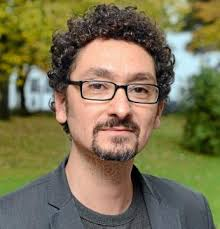

David Foenkinos is one of contemporary France’s most beloved novelists — a writer whose books manage to be simultaneously funny and heartbreaking, intellectually precise and emotionally wide open. With more than seventeen novels translated into over forty languages, he occupies an unusual position in French literary culture: critically respected, commercially successful, and genuinely popular with readers who might not otherwise identify as literary fiction enthusiasts. His story — of a man who barely read as a child, who fell in love with books during a prolonged hospital stay at sixteen, and who went on to win France’s most prestigious literary prizes — has the shape of one of his own novels.
David Foenkinos Biography
| Full Name | David Foenkinos |
|---|---|
| Date of Birth | October 28, 1974 |
| Place of Birth | Paris, France |
| Nationality | French |
| Profession | Novelist, Playwright, Screenwriter, Director |
| Education | Literature, Sorbonne; Music, Centre d’informations musicales (jazz school) |
| Known For | La Délicatesse (2009); Charlotte (2014, Prix Renaudot); novels translated into 40+ languages |
| Sibling | Stéphane Foenkinos (film director) |
Early Life and Background
David Foenkinos was born on October 28, 1974, in Paris, France, into a home that was not, by his own admission, particularly literary. His parents were often absent, books were not a prominent feature of family life, and he grew up reading and writing very little. Nothing in his childhood pointed obviously toward a career as a novelist.
The turning point came at age sixteen, when Foenkinos required emergency surgery for a rare and serious pleural infection. The recovery was lengthy, stretching across several months of hospitalization. In the hospital, deprived of his usual routines and faced with an unusual amount of time alone, he began reading voraciously. Books flooded into the space that illness had opened. He also began to paint and to play guitar during this period — outlets that would remain part of his identity. The experience, he has said in interviews, left him with a powerful drive for life that he has tried to convey through everything he has written since. It is not a trivial observation: his best novels are suffused with a particular awareness of how fragile, how brief, and how strange ordinary human happiness can be.
Education
After his recovery, Foenkinos pursued two parallel academic paths: literature at the Sorbonne — one of France’s oldest and most prestigious universities — and music at a jazz school in Paris (the Centre d’informations musicales). He graduated from both programs, though his professional life would eventually tip decisively toward writing. For a period, he supported himself by teaching guitar while working on fiction in the evenings. He also worked as a waiter in a restaurant — a combination of jobs that gave him time, modest income, and an endless supply of human observation.
Career: From Failed Manuscripts to Literary Stardom
Foenkinos’s path to publication was not immediate. He wrote several manuscripts that went nowhere before finding his style and his voice. His first novel, Inversion de l’idiotie: de l’influence de deux Polonais (published by Gallimard in 2002), was rejected by many publishers before Gallimard — France’s most distinguished literary publisher — took it on. The gamble paid off: the book earned him the François-Mauriac Prize from the Académie Française, marking his arrival on the French literary scene as a genuine talent.
A series of novels followed, each building his readership. His third novel, Entre les oreilles, won the Jean-Claude Brialy Prize in 2003 and the Prix Roger-Nimier in 2004, selling more than 100,000 copies in France. His output continued steadily through the 2000s, with each new book developing his signature combination of wit, melancholy, and unexpected emotional depth.
The breakthrough came in 2009 with La Délicatesse — a novel about a young woman navigating grief and the unexpected return of feeling after loss. The book became a massive bestseller in France, eventually selling around one million copies. Foenkinos and his brother Stéphane co-directed the film adaptation in 2011, starring Audrey Tautou and François Damiens. The film was commercially successful and brought his work to an international audience that extended well beyond habitual readers of French literary fiction.
Charlotte: The Work That Changed Everything
If La Délicatesse made David Foenkinos famous, Charlotte (2014) established him as a writer of genuine literary consequence. The novel — written in a spare, spare-line-by-line prose style unlike anything he had done before — tells the story of Charlotte Salomon, a young German Jewish artist who was murdered at Auschwitz in 1943 at the age of 26. Foenkinos had first encountered Salomon’s work in 2006 at a small Paris exhibition and describes the discovery as having changed his life. He spent eight years researching and writing the book, an obsession that at times made him doubt whether he would ever finish it — or whether, having finished it, he could write anything else.
Charlotte won both the Prix Renaudot and the Prix Goncourt des Lycéens in 2014 — two of France’s most prestigious literary awards — and was translated into more than thirty languages. For Foenkinos, it represented the most important artistic act of his career and a profound act of memorial for an artist he felt had been unjustly forgotten by history.
Later Works and Cinema
The novels that followed Charlotte have continued Foenkinos’s characteristic exploration of love, loss, identity, and the strange randomness of human fate. Le Mystère Henri Pick (The Mystery of Henri Pick) became another bestseller in France — a witty comic mystery about literary fame and the discovery of a manuscript by an unknown dead Frenchman. It was adapted into a film starring Fabrice Luchini and Camille Cottin, which attracted nearly 900,000 admissions in France. His 2022 novel Numéro Deux imagines the alternate life of the boy who almost — but didn’t — get the role of Harry Potter, and his 2024 novel Tout le monde aime Clara continues his exploration of how people’s inner lives diverge from their public appearances.
Writing Style and Themes
Foenkinos writes about love, loss, missed connections, and the small moments that determine the shape of a life. His prose is distinctive: light and precise in the French literary tradition, but warmed by a genuine emotional generosity toward his characters. He has spoken about his discomfort with what he calls “vampirism of reality” — the practice of mining the lives of real people for fictional material — and works hard to protect the boundary between observation and exploitation. His female characters in particular are frequently cited by critics as among the most complex and carefully drawn in contemporary French fiction.
Personal Life
David Foenkinos lives in Paris with his family. He is the brother of Stéphane Foenkinos, a film director, with whom he has collaborated on several film projects. He has spoken about Paris as a city that feeds his imagination and whose rhythms are deeply embedded in his work. Specific details about his romantic life and family situation are not publicly disclosed.
Net Worth
David Foenkinos is one of France’s commercially most successful literary novelists, with sales in France and internationally that run into the millions of copies. His income derives from book royalties across more than forty languages, film adaptation fees, and his work as a screenwriter and director. Specific net worth figures are not publicly confirmed, but his commercial success in France and internationally places him among the most financially successful authors in contemporary French literature.
Frequently Asked Questions
What is David Foenkinos best known for?
He is best known for La Délicatesse (2009), a bestselling novel adapted into a film starring Audrey Tautou, and for Charlotte (2014), which won the Prix Renaudot and Prix Goncourt des Lycéens.
When was David Foenkinos born?
He was born on October 28, 1974, in Paris, France.
How many languages have his novels been translated into?
His novels have been translated into more than forty languages worldwide.
Who is Stéphane Foenkinos?
Stéphane Foenkinos is David’s brother and a film director. The two brothers co-directed the 2011 film adaptation of La Délicatesse.
What award did David Foenkinos win in 2014?
He won both the Prix Renaudot and the Prix Goncourt des Lycéens in 2014 for his novel Charlotte, about the German Jewish artist Charlotte Salomon.
Editorial Notice
The biography above is compiled from publicly available sources and is intended for general informational purposes only. At PeopleCabal, we are committed to accuracy — however, public records evolve, and some details may change over time. If you notice anything that requires a correction or update, we welcome you to reach out to us directly.
