
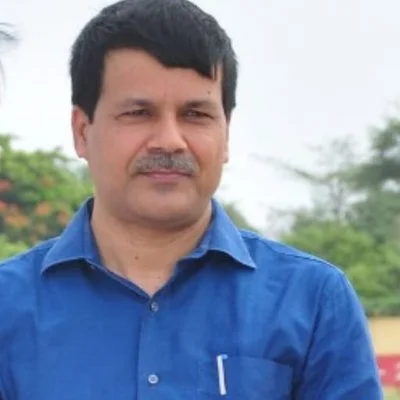
Ashwani Kumar IAS Biography – Wife , Date Of Birth, Education, Career & Net Worth (Gujarat Cadre, 1997 Batch)

There is a particular kind of IAS officer who doesn’t just occupy administrative chairs but visibly reshapes the systems they oversee. Ashwani Kumar is that kind of officer. Born in a small district of Uttar Pradesh, educated at one of India’s most elite engineering institutions, and trained further at one of Britain’s most prestigious universities, he brought an unusual combination of technical depth and policy sophistication to the Gujarat cadre — and has spent nearly three decades making it count.
What makes his career genuinely interesting isn’t just its length, but its range. He has served as a District Collector navigating ground-level governance, as Municipal Commissioner managing one of Gujarat’s major urban centres, as Secretary to the Chief Minister steering state-level policy from the top, and now as Principal Secretary in one of the most strategically critical departments in a state that is driving India’s energy future. That kind of breadth, across field administration, urban development, infrastructure, and energy policy, is rare even among senior IAS officers.
He is a 1997-batch IAS officer of the Gujarat cadre, currently serving as Principal Secretary of the Energy and Petrochemicals Department, Government of Gujarat.
| Ashwani Kumar | |
|---|---|
 Ashwani Kumar IAS Biography – Wife , Date Of Birth, Education, Career & Net Worth (Gujarat Cadre, 1997 Batch): History · Bio · Photo
|
|
| Wiki Facts & About Data | |
| Full Name: | Ashwani Kumar |
| Date of Birth: | 28 April 1975 |
| Age: | 51 Years |
| Place of Birth: | Saidpur, District Ghazipur, Uttar Pradesh |
| Nationality: | Indian |
| Occupation: | IAS Officer (Indian Administrative Service) |
| Religion: | Not publicly disclosed |
| Spouse/Partner: | Not publicly disclosed |
| Net Worth: | Not publicly confirmed |
| Education: | B.Tech (Chemical Engineering, IIT Kanpur); M.Sc (Public Services, Policy & Management, King's College London) |
| Social / Web: | 📸 @ashwaniias |
Early Life and Background
Ashwani Kumar was born on 28 April 1975 in Saidpur, District Ghazipur, Uttar Pradesh. Ghazipur is a historically significant district in eastern UP — known for its opium factory from colonial times and its position along the Ganga river — but it is not typically associated with producing IIT alumni and senior IAS officers. That alone signals something about his early drive and academic seriousness
Details about his parents and family background have not been disclosed publicly, which is consistent with how most serving IAS officers handle personal information. What is clear, however, is that his formative years in Uttar Pradesh gave him the groundwork to crack one of the world’s most competitive undergraduate entrance examinations — the IIT-JEE — and then, years later, the UPSC Civil Services Examination.
He appeared in the Civil Services Examination in 1996 and cleared it at a young age of around 22 years, a remarkable achievement that speaks to both his intellectual ability and his early sense of purpose. Choosing to enter public service after an engineering education from IIT is itself a conscious decision — one that many engineers of his generation made, but not all followed through on with the same commitment he has demonstrated over nearly three decades.
Education
Ashwani Kumar’s academic profile is genuinely exceptional, even by IAS standards.
He holds a B.Tech in Chemical Engineering from the Indian Institute of Technology (IIT) Kanpur and a Master’s Degree in Public Services, Policy & Management from King’s College, London.
IIT Kanpur is consistently ranked among the top engineering institutions in India and Asia, and the Chemical Engineering programme is one of its most rigorous departments. Earning a degree there requires not just hard work but genuine aptitude for mathematics, thermodynamics, process systems, and analytical problem-solving — skills that, as his career would prove, translate remarkably well into policy-making around energy and infrastructure.
His postgraduate degree from King’s College London, specifically in Public Services, Policy and Management, is equally notable. King’s College is a Russell Group university with a strong tradition in public policy and governance studies. This qualification gave Ashwani Kumar the conceptual vocabulary of policy analysis, service delivery, and institutional management — essentially the theoretical scaffolding for everything he would go on to implement on the ground in Gujarat.
This combination — technical engineering from IIT Kanpur, policy management from King’s College — is extraordinarily rare in the IAS, and it almost certainly explains the depth with which he has handled portfolios spanning urban development, infrastructure, energy, and petrochemicals.
Career Journey: From Collector to Principal Secretary Across Gujarat’s Most Strategic Departments
The Formative Years: District Administration
Every IAS officer begins with district-level postings, but not all of them learn the same lessons from it. Throughout his career, Ashwani Kumar has held various key roles including Principal Secretary, Secretary to the Chief Minister, Managing Director, Chief Electoral Officer, Municipal Commissioner, District Collector, and Assistant Collector.
His early postings as Assistant Collector and then District Collector gave him direct exposure to how governance actually works at the citizen interface — land records, revenue administration, law and order, disaster response, and welfare delivery. For an IIT engineer, this was an education of a very different kind, and officers who absorb it well carry that ground-level instinct throughout their careers.
Chief Electoral Officer and Democratic Accountability
One of the more distinctive roles in his career was that of Chief Electoral Officer — a position that places an IAS officer at the fulcrum of India’s democratic process within a state. Managing elections in Gujarat, one of India’s most politically significant states, requires precision, political neutrality, and logistics mastery at scale. His tenure in this role reflects the kind of trust the administration placed in his competence and integrity.
Municipal Commissioner and Urban Development
His role as Municipal Commissioner placed him in charge of urban governance — one of the fastest-evolving and most politically visible challenges in 21st-century India. Gujarat’s cities, particularly Ahmedabad and Surat, have been among the most actively developed urban centres in India over the past two decades, and managing their municipal frameworks demanded both technical knowledge and administrative agility.
His tenure at the Chief Minister’s Office in Gujarat was instrumental in driving policy implementation, infrastructure development, and urban governance. As Secretary to the Chief Minister — a role that essentially makes an officer the administrative right hand of the state’s most powerful executive — he was embedded at the intersection of political direction and administrative execution. This is where policy gets shaped, priorities get set, and decisions with state-wide consequences get made in real time.
Principal Secretary: Urban Development, Ports, Transport and Beyond
Ashwani Kumar, a 1997-batch Gujarat cadre IAS officer who served as the then Chief Minister Vijay Rupani’s secretary, was appointed Principal Secretary at the Urban Development Department. From that appointment, his trajectory through the secretariat only widened.
He also served as the Chairman of Gujarat Urban Development Company Limited and Urban Ring Development Corporation Limited, and as a Nominee Director on the boards of several key organisations, including GIFT City Company Limited, Gujarat Metro Rail Corporation Limited, Diamond Research and Mercantile City Limited, Gujarat Town Planning Consultancy Limited, and Gujarat Sports Infrastructure Development Company.
This board-level involvement across multiple major Gujarat entities — from GIFT City (India’s first operational smart city and international financial services centre) to the Gujarat Metro Rail Corporation — illustrates how deeply embedded he has been in the state’s infrastructure agenda.
Current Role: Principal Secretary, Energy and Petrochemicals
Since December 2025, Ashwani Kumar has been serving as Principal Secretary of the Energy and Petrochemicals Department, Government of Gujarat. This is, arguably, one of the most consequential postings in the state government right now.
Gujarat is India’s leading state in renewable energy — it accounts for a significant share of India’s solar and wind energy capacity — and it hosts major petrochemical clusters including Dahej and Hazira. Managing energy policy in this context means overseeing a sector that directly affects industrial competitiveness, climate commitments, and energy security for millions.
His other directorships include Gujarat State Petroleum Corporation, Gujarat Urja Vikas Nigam, Gujarat Power Corporation, Gujarat Energy Transmission Corporation, Gujarat Gas, and Gujarat Narmada Valley Fertilizers & Chemicals. This portfolio of board positions in the energy and chemicals ecosystem reflects the breadth of institutional oversight he now exercises in this space.
Additionally, GSFC (Gujarat State Fertilizers & Chemicals Limited) sought shareholder approval in 2026 for his appointment as Director on its board, further cementing his presence across Gujarat’s state-owned enterprise landscape
Leadership Style and Contributions to Governance
What is striking about Ashwani Kumar’s career is the consistency of his institutional engagement. He has not merely held positions — he has accumulated influence across interconnected domains: urban development feeding into infrastructure, infrastructure feeding into energy, energy feeding into industrial policy. In Gujarat’s governance model, where the state has historically taken a proactive role in economic development, officers like him serve as the connective tissue between political ambition and administrative delivery.
His dual educational identity — the IIT engineer and the King’s College policy scholar — appears to manifest in a governance style that is simultaneously analytical and institutional. He understands systems from the inside (the engineering way) and structures for scale (the policy way). That combination is visible in the range of technical boards he chairs and the infrastructure-heavy portfolios he has led.
His multilingual proficiency in English, Hindi, and Gujarati also reflects a cultural adaptability that matters in a state where the bureaucracy operates in Gujarati, state politics is conducted in both Gujarati and Hindi, and national-level policy engagement requires fluent English.
Personal Life
Ashwani Kumar has maintained a consistent and deliberate privacy around his personal life, which is a choice many senior civil servants make given the public nature of their official roles. Details about his wife are not available in public records, and he has not made statements about his family in any official capacity.
What is known is that he was born and raised in Ghazipur, Uttar Pradesh, before his academic journey took him to Kanpur and later to London. His personal life has remained firmly outside public documentation — a reflection of professional boundaries rather than any notable circumstance.
Net Worth
Ashwani Kumar’s net worth has not been publicly confirmed and any specific figure would be speculative. As a Principal Secretary in the Government of Gujarat, his income is governed by the 7th Pay Commission pay matrix applicable to senior IAS officers. Officers at this level receive a substantial government salary supplemented by allowances, official accommodation, and various service-linked entitlements.
He is expected to retire on 30 April 2035, meaning he still has several years of active service ahead, during which his compensation structure will continue within the government pay framework.
Conclusion
Ashwani Kumar’s career tells a story that is rare in Indian public administration — an IIT-trained chemical engineer who layered global policy education onto his technical foundation, then spent nearly three decades navigating Gujarat’s most demanding administrative and infrastructural challenges. From district administration in the early years to shaping urban policy, overseeing elections, running municipal corporations, and now steering Gujarat’s energy and petrochemicals sector, he has been present at nearly every major inflection point in the state’s modern governance story.
At a time when India’s energy transition is accelerating and Gujarat is positioned at its centre, having someone with his combined depth of technical and policy understanding in charge of the Energy and Petrochemicals Department is not incidental. It is, in many ways, the logical destination of a career built precisely for this kind of challenge.
Follow updates on Ashwani Kumar IAS: Instagram (@ashwaniias)
Frequently Asked Questions (FAQs)
Q1. Who is Ashwani Kumar IAS? Ashwani Kumar is a 1997-batch IAS officer of the Gujarat cadre, currently serving as Principal Secretary of the Energy and Petrochemicals Department, Government of Gujarat. He is known for his technical background from IIT Kanpur and policy education from King’s College London.
Q2. Where was Ashwani Kumar IAS born? He was born on 28 April 1975 in Saidpur, District Ghazipur, Uttar Pradesh.
Q3. What is Ashwani Kumar’s educational qualification? He holds a B.Tech in Chemical Engineering from IIT Kanpur and a Master’s in Public Services, Policy & Management from King’s College, London.
Q4. What is Ashwani Kumar’s current posting in 2026? As of 2026, he is serving as Principal Secretary of the Energy and Petrochemicals Department, Government of Gujarat, a position he assumed on 22 December 2025.
Q5. When will Ashwani Kumar IAS retire? He is scheduled to retire on 30 April 2035.
Editorial Notice
The biography above is compiled from publicly available sources and is intended for general informational purposes only. At PeopleCabal, we are committed to accuracy — however, public records evolve, and some details may change over time. If you notice anything that requires a correction or update, we welcome you to reach out to us directly.
