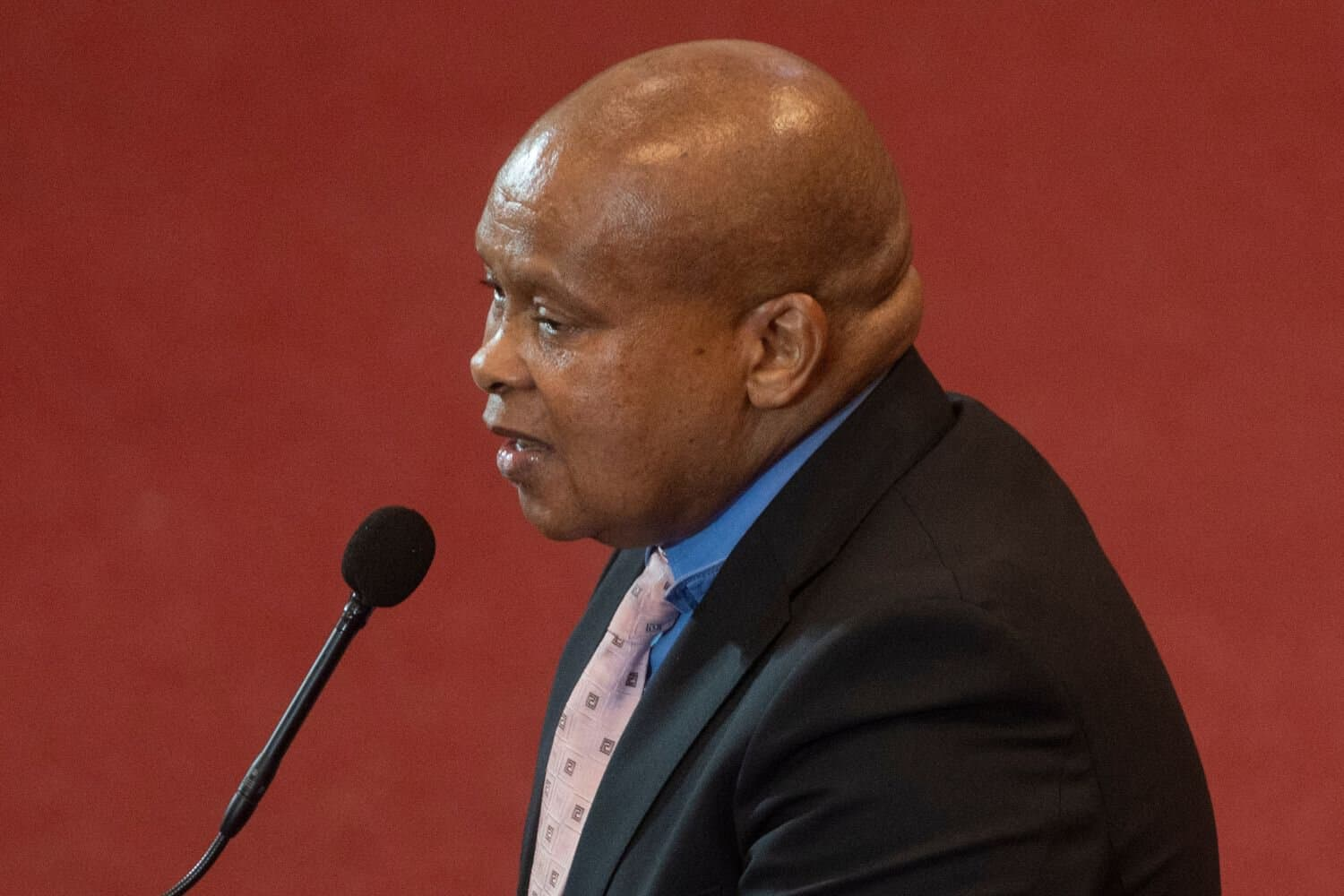

Who Was Bushy Maape? There are politicians who seek power, and then there are those on whom power is thrust — because the circumstances of their time leave no room for bystanders. Kaobitsa “Bushy” Maape belonged firmly in the second category.
He was a South African ANC veteran, former political prisoner, and the seventh Premier of the North West Province. But to reduce him to a job title would be to misunderstand the man. Long before he ever chaired a cabinet meeting or addressed a legislature, Maape was running from apartheid security forces, building underground resistance cells across the Kgalagadi region, and sitting in a cell on Robben Island — reading textbooks while serving time for fighting for the country he would one day help govern.
On 17 May 2026, Bushy Maape passed away at the age of 68 in a Johannesburg hospital, surrounded by family, after a short illness. South Africa lost a freedom fighter. The North West lost a son.
Bushy Maape Biography
| Detail | Information |
|---|---|
| Full Name | Kaobitsa “Bushy” Maape |
| Date of Birth | 28 July 1957 |
| Date of De@th | 17 May 2026 |
| Age at De@th | 68 |
| Place of Birth | Vryburg, North West Province, South Africa |
| Nationality | South African |
| Profession | Politician, Freedom Fighter, Public Servant |
| Party | African National Congress (ANC) |
| Position Held | Premier of the North West Province (2021–2024) |
| Education | BA Psychology & Economics (UNISA); BA Hons Developmental Studies & Economics (UWC) |
| Religion | Not publicly stated |
| Children | Six |
| Siblings | Five (including Neo Maape) |
Early Life and Background
Bushy Maape was born on 28 July 1957 in Vryburg, a dusty town in what is now the North West Province of South Africa. To grow up in apartheid-era Vryburg in the late 1950s and 1960s was to grow up with a very clear understanding of who the state considered a citizen and who it did not.
The Kgalagadi region where Maape was raised is a place of wide skies, sparse vegetation, and communities that had to be resilient by necessity. It was not a place of grand opportunity under apartheid — but it was a place where the injustice of racial classification was felt every single day, in every school queue, every pass book, every road that was paved on one side of town and left to dust on the other.
By the time the 1976 Soweto student uprisings spread their electricity across the country, Maape was nineteen years old — and the revolt’s spirit found him. He would not stay passive for long.
Education
What Maape did with his time on Robben Island is, in many ways, the most quietly extraordinary part of his story.
While imprisoned — a fact alone that would define most lives — he pursued a Bachelor of Arts degree in Psychology and Economics through the University of South Africa (UNISA). He completed that degree while incarcerated on Robben Island in the 1980s. It is worth pausing on that. He studied the mechanics of the human mind and the dynamics of economic systems while the South African state tried to neutralise him as a threat.
After his release, his educational ambitions did not stop. He went on to earn:
- BA (Honours) in Developmental Studies — University of the Western Cape (UWC)
- BA (Honours) in Economics — University of the Western Cape (UWC)
The University of the Western Cape, it should be noted, was historically designated for Coloured students under apartheid — but it became a hotbed of progressive academic thought and anti-apartheid scholarship. That Maape chose to study there was itself a statement.
The Underground Years: A Movement Built in Secret
After the 1976 student uprisings, Bushy Maape made a dangerous decision: he skipped the country. He crossed the border and received political and military training from the ANC in exile — the kind of training that, if discovered, would earn a person a long sentence or something worse.
But Maape came back. That is perhaps the most telling thing about him. He infiltrated back into South Africa and formed and commanded the Kgalagadi underground, a covert ANC structure that operated across a vast stretch of the northern interior — Mahikeng, Vryburg, Taung, Kuruman, and Kimberley.
Think of what that required: recruitment in whispers, logistics managed without modern communication tools, cells that couldn’t afford to know too much about each other in case anyone was caught and broken under interrogation. It was, by any measure, high-stakes, dangerous work. It was also work that Maape chose and sustained — not for a week, but across years.
Robben Island and the Price of Conviction
The apartheid state eventually caught up with him. In the 1980s, Maape was arrested and incarcerated on Robben Island — the same windswept prison island off the Cape coast that held Nelson Mandela and countless other South African political prisoners.
Robben Island was designed to break people — to isolate them, to make them feel forgotten by the world outside. For many, it did exactly that. But for others, like Maape, it became something else entirely: a university of the spirit, and, in his case, a literal university. He used his imprisonment to study. He earned his degree. He kept his mind active and his convictions intact.
This chapter of his life was not incidental to who he became as a leader. It was foundational. You cannot understand how Maape governed — his ethical compass, his reported incorruptibility, his focus on communities — without understanding what he was willing to endure for those principles.
Life After Apartheid: From Activist to Administrator
When South Africa’s first democratic elections arrived in 1994, Maape transitioned from resistance fighter to public servant. He took up senior roles in the North West provincial government, including overseeing RDP (Reconstruction and Development Programme) programmes and working in strategic planning within the Premier’s Office.
These were not glamorous postings. RDP implementation in rural provinces was the unglamorous, grinding work of governance — housing lists, service delivery disputes, budget allocations, contractor accountability. But it was precisely the kind of work that built institutional knowledge and an understanding of how government either serves or fails its people at the ground level.
Over the years, Maape worked his way through various leadership roles within the ANC structures in the Kgalagadi region, building both his political standing and his reputation as a reliable, steady hand.
Premier of the North West: Stepping Up When It Mattered
In September 2021, Bushy Maape was appointed Premier of the North West Province — not under ordinary circumstances, but in the middle of a governance crisis. He was, as one account described it, “recalled from retirement to stabilise” a province that had been placed under Section 100 administration — a constitutional mechanism triggered when a province fails so significantly in its functions that the national government must intervene.
The North West had been plagued by mismanagement, corruption allegations, and collapsed service delivery. Maape inherited a mess. He took on the job not because the timing was ideal, but because the situation demanded someone with both credibility and experience.
He served as the seventh Premier of the North West from 2021 to 2024. During his tenure, the province was successfully removed from Section 100 administration — a not-insignificant achievement that is often overlooked in coverage of his time in office.
Key Achievements in Office
- Stabilised provincial governance during one of the North West’s most turbulent administrative periods
- Led the province out of Section 100 administration, restoring functional provincial governance
- Championed community empowerment and education as central pillars of governance
- Maintained a reputation — acknowledged even by critics — for ethical leadership and incorruptibility
- Prioritised service delivery and held firm on good governance principles during a difficult political climate
The ANC described him as having served “with discipline, humility, and unwavering commitment to the people.” Even in political life, where such language is often ceremonial, his legacy carries the weight of those words.
The Pothole Controversy — and What It Revealed
No account of Maape’s premiership would be complete without mentioning the pothole remarks of 2023, which became one of the most-discussed moments of his term — and not for the reasons he intended.
During a debate in the provincial legislature, Maape claimed he could travel from Mahikeng to Rustenburg — approximately 194 kilometres — without hitting a single pothole. He extended the same claim to routes toward Klerksdorp and Schweizer-Reneke.
The remarks triggered immediate and sustained public reaction. Many South Africans — who had firsthand experience with the state of provincial roads — were deeply sceptical, and some were outright angry. The episode sparked a broader debate about service delivery perceptions and the gap between leadership accounts of provincial conditions and residents’ daily reality.
It was a revealing moment, not because it defined Maape’s governance record, but because it illustrated how even experienced leaders can misjudge the public mood on service delivery — a subject South Africans feel acutely.
Health Struggles and Final Years
In 2023, Maape took several months of medical leave following orthopaedic surgery at Wilmed Park Hospital. It was clear his health was a serious concern, though he continued in his role.
In 2024, he travelled to Thailand for further medical treatment, on the referral and advice of his doctors. Opposition parties questioned the trip; the ANC defended it, stating the treatment was medically necessary and that Maape had personally covered the cost.
After the 2024 national and provincial elections, Maape did not return to the premier’s office. He stepped back from frontline political life — though, given his health, this was understood to be connected to his ongoing medical challenges rather than any political development.
He died on Saturday, 17 May 2026, in a Johannesburg hospital, after a short illness. His brother, Neo Maape, confirmed the news. His six children were at his side.
Personal Life: Family, Children, and Legacy
Bushy Maape was, by all family accounts, a man whose warmth extended well beyond formal settings. His family described him as “a loving, humble, kind-hearted, and respected man whose presence brought warmth, wisdom, and strength.”
He is survived by six children and five siblings, including his brother Neo Maape, who confirmed his passing to the press. The family’s statement said simply: “He ran his race, and we are grateful that we had an opportunity to share our lives with him.”
Details about a spouse are not confirmed in available public records. His family kept his personal life appropriately private throughout his years in public service — a boundary that deserves to be respected.
Net Worth and Financial Profile
Bushy Maape’s net worth has not been publicly disclosed or confirmed through any verified source. His income was primarily drawn from his long career in public service — as a provincial government official and later as Premier of the North West, a position that carries a government salary regulated by South African public service frameworks.
There is no credible basis to assign a specific figure. Any numbers circulating online should be treated with scepticism. What is documented is that he personally paid for his medical treatment in Thailand — suggesting he managed his personal finances independently, though the specifics remain private.
De@th and Tributes
Bushy Maape passed away on 17 May 2026, in Johannesburg. He was 68 years old.
The tributes came swiftly and from across the political and social spectrum. North West Premier Lazarus Mokgosi confirmed the news and described him as “a true servant of the people” who was “ethical and incorruptible.” The ANC issued a formal statement, saying it “dips its revolutionary banner in honour of comrade Bushy Maape.”
ANC national spokesperson Mahlengi Bhengu described his life as representative of a generation that sacrificed profoundly for the country’s freedom — a generation, she implied, that is now rapidly passing.
The ANC’s tribute read: “His life remains a testament to a generation of cadres who sacrificed greatly for freedom, democracy, education, and development in South Africa.”
For more on tributes and official statements, see:
Conclusion
How do you measure a life like Bushy Maape’s? Not by the controversy of a pothole remark, and not merely by the titles he held. You measure it by what it cost him — and by what he did with what remained after the cost was paid.
He was imprisoned for his beliefs, studied through his imprisonment, built resistance networks in the dark, and then — when democracy came — showed up to do the unglamorous work of actually governing. When the North West was in crisis, he answered the call. When his health began to fail, he kept going until he couldn’t.
“He ran his race,” his family said. That is exactly right. And it was a long, hard, remarkable one.
Frequently Asked Questions
1. Who was Bushy Maape? Bushy Maape, full name Kaobitsa “Bushy” Maape, was a South African ANC veteran, former political prisoner, and the seventh Premier of the North West Province. He served as Premier from 2021 to 2024.
2. When did Bushy Maape die? Bushy Maape passed away on Saturday, 17 May 2026, in a Johannesburg hospital after a short illness. He was 68 years old.
3. Was Bushy Maape imprisoned on Robben Island? Yes. In the 1980s, Maape was incarcerated on Robben Island following his involvement in anti-apartheid underground activities. He earned a degree in psychology and economics from UNISA while imprisoned there.
4. What did Bushy Maape achieve as North West Premier? Among his key achievements, he helped stabilise the North West Province after a period of severe mismanagement and successfully led the province out of Section 100 administration — a measure that signals restoration of functional provincial governance.
5. How many children did Bushy Maape have? Bushy Maape is survived by six children, as confirmed by his family following his passing.
Editorial Notice
The biography above is compiled from publicly available sources and is intended for general informational purposes only. At PeopleCabal, we are committed to accuracy — however, public records evolve, and some details may change over time. If you notice anything that requires a correction or update, we welcome you to reach out to us directly.
