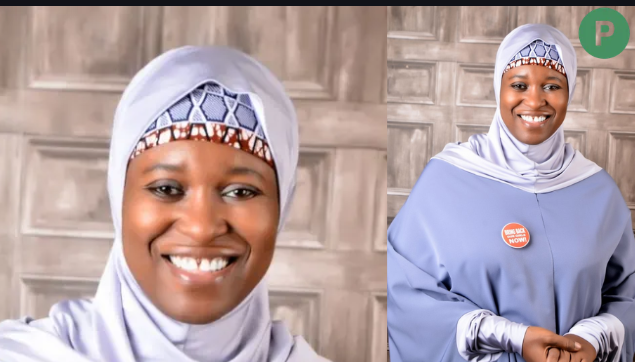

There’s a photograph that many Nigerians will never forget. A woman in a hijab, fist raised, standing firm in the middle of the Lekki tollgate during the October 2020 #EndSARS protests. That woman was Aisha Yesufu — and that image said everything about who she is before she even opened her mouth.
But Aisha Yesufu is more than a protest photograph. She is a human rights activist, a co-founder of the Bring Back Our Girls movement, a businesswoman, and now — as of 2026 — a declared senatorial candidate preparing to contest the FCT Senate seat in the 2027 Nigerian general elections. Her trajectory from a young girl in Kano, surrounded by peers who were being married off before adolescence ended, to one of Nigeria’s most recognised civil society voices, is the kind of story that deserves more than bullet points.
| Aisha Somtochukwu Yesufu | |
|---|---|
|
|
|
| Wiki Facts & About Data | |
| Full Name: | Aisha Somtochukwu Yesufu |
| Place of Birth: | Kano State, Nigeria |
| State of Origin: | Agbede, Edo State |
| Nationality: | Nigerian |
| Occupation: | Activist, Businesswoman, Political Aspirant |
| Religion: | Islam |
| Known For: | #BringBackOurGirls, #EndSARS |
| Social / Web: | 📸 @AishaYesufu |
Early Life: Growing Up in Kano
Aisha Somtochukwu Yesufu was born and raised in Kano State, in Nigeria’s predominantly Muslim north — though her family’s roots trace back to Agbede, in Edo State, in the country’s south. That combination alone — a southern Edo heritage lived out in northern Kano — shaped someone who early in life had to negotiate multiple identities, cultural expectations, and social realities simultaneously.
Kano is one of Nigeria’s oldest and most culturally layered cities. It is a place of commerce, Islamic scholarship, and deep-rooted traditions — including, historically, entrenched patriarchal structures that have shaped the lives of women and girls in ways that range from limiting to outright harmful.
Aisha grew up inside that environment. And what it produced, rather than compliance, was clarity.
The World She Grew Up In
Here is the detail that contextualises everything that came after: by the time Aisha Yesufu was eleven years old, she had no female friends left. Not because she was antisocial. But because her peers — girls her age — had either been married off or had died in childbirth.
Let that sit for a moment. At eleven, in the early years of what should have been an uncomplicated childhood, she was already witnessing the consequences of systems that treated girls as liabilities to be offloaded rather than people with futures worth protecting.
This is not background colour. It is the origin point of her activism. The outrage that would later drive her to stand at Lekki tollgate, fist raised, did not appear from nowhere. It was cultivated, slowly and painfully, in a Kano neighbourhood where girlhood had an expiry date.
Education and Intellectual Formation
Aisha Yesufu pursued formal education in Nigeria. Specific details about her secondary and tertiary academic institutions have not been extensively documented in verified public sources, and it would be inaccurate to fill those gaps with speculation.
What is evident, however, is that she developed a sharp analytical mind, a command of public discourse, and an ability to communicate complex political and social ideas in language that ordinary Nigerians find accessible. These are not qualities that come from a single degree — they come from years of reading, organising, arguing, and refusing to stop asking uncomfortable questions.
Her education, in the fullest sense, has been ongoing — and largely self-directed.
From Business to Activism
Before the protest placards and television interviews, Aisha Yesufu built a career in business. She has worked as an entrepreneur and has spoken publicly about the importance of economic independence for women — a conviction rooted, clearly, in her own experience.
The transition from businesswoman to public activist was not a sharp break. It was more of a gradual expansion — a woman who was already engaged with her community beginning to direct that engagement outward, toward the systems causing harm on a larger scale.
Nigeria in the 2010s provided no shortage of provocations. Corruption, insecurity, institutional failure — the conditions were, unfortunately, ripe for someone with Aisha’s temperament and clarity of purpose to find a cause that demanded her full attention.
Bring Back Our Girls: A Movement That Shook the World
In April 2014, the terrorist group Boko Haram abducted 276 schoolgirls from the Government Girls Secondary School in Chibok, Borno State. The Nigerian government’s initial response was slow and, to many observers, grossly inadequate. What followed was one of the most remarkable examples of civilian-led advocacy in modern Nigerian history.
Aisha Yesufu became a co-founder of the Bring Back Our Girls (BBOG) movement, a coalition of activists, civil society figures, and ordinary Nigerians who refused to let the story disappear. The movement gained global traction — the hashtag #BringBackOurGirls was shared by Michelle Obama, Malala Yousafzai, and millions of others worldwide.
But beyond the hashtag, BBOG maintained consistent pressure on the Nigerian government for years. Aisha and her fellow activists held daily sit-outs in Abuja, faced harassment, and continued showing up even when the media cycle had long moved on. It was grinding, often thankless work — and it established her as someone with genuine staying power, not just social media visibility.
#EndSARS and the Photograph That Defined a Generation
In October 2020, Nigerian youth took to the streets to protest against the Special Anti-Robbery Squad (SARS), a police unit with a long, documented history of brutality, extortion, and extrajudicial killings. The protests were largely leaderless and youth-driven — but certain figures became visible symbols of the movement.
Aisha Yesufu was among them. Her presence at the Lekki tollgate — calm, resolute, fist in the air — became one of the defining images of that period. When security forces opened fire on protesters at Lekki on October 20, 2020, in what became known as the Lekki Massacre, the footage and images from that night, including those featuring Aisha, circulated globally.
She has never walked back her involvement or her anger. She has continued to demand accountability for what happened that night — and that consistency matters in a political environment where yesterday’s activist often becomes tomorrow’s establishment figure.
Her Leadership Style: Why She Connects
What distinguishes Aisha Yesufu from many figures in Nigerian civil society is the absence of performance. She does not speak in the elevated, distancing language that activists sometimes adopt when they begin to see themselves as leaders rather than participants. She is blunt, often funny, occasionally provocative — and consistently direct.
On social media, particularly Twitter/X, she has built a following not through polish but through persistence. She says what she thinks, engages her critics directly, and does not soften difficult truths for the sake of palatability.
This approach has attracted both admirers and detractors. But it has also given her a credibility that more carefully managed public figures often lack — because people believe she means what she says.
Ethnicity, Tribe, and Identity
Aisha Yesufu’s heritage is Edo — specifically from Agbede, a town in Edo State in southern Nigeria. The Edo people have a rich cultural history, deeply tied to the ancient Benin Kingdom, one of the most sophisticated pre-colonial states in West Africa.
She was, however, raised in Kano, in the predominantly Hausa-Fulani north. This duality — Edo roots, northern upbringing, Muslim faith — makes her a genuinely cross-cultural figure in a country that is often discussed in terms of its divisions rather than its complexities.
She has spoken publicly about navigating these intersections, and her activism consistently resists the ethnic and regional tribalism that undermines Nigerian civic life.
Religion and Its Role in Her Activism
Aisha Yesufu is Muslim, and her faith is visibly part of her public identity — she wears a hijab and has spoken about her spirituality in various interviews. But her Islam is not the kind that shrinks from controversy or defers to authority.
She has been a consistent voice against the manipulation of religion for political purposes in Nigeria. She challenges both secular and religious power structures when she believes they are failing ordinary people. Her faith appears to be a source of personal grounding rather than a limiting framework — and that distinction matters when assessing why she connects with such a wide range of Nigerians across different backgrounds.
Personal Life: Husband and Family
Aisha Yesufu is married to Bilyamin Yesufu, and the couple have children together. She has spoken warmly and publicly about her family, often crediting her husband’s support as foundational to her ability to do the work she does — which is, in the context of Nigerian social expectations around gender and marriage, a meaningful acknowledgment.
She is, by her own account, deeply committed to both her family and her public work. The fact that she has maintained both over years of intense activism — including periods of real personal risk — says something about the structures of support she has built around herself.
Net Worth and Financial Background
Aisha Yesufu’s net worth has not been publicly confirmed, and circulating estimates online are largely unverified. Her income has come primarily from her business activities and, more recently, from public speaking engagements and advocacy work.
She is not known for the ostentatious displays of wealth that often accompany public prominence in Nigeria — which, given her vocal criticism of corruption and elite excess, would be difficult to reconcile. Whether her financial position is modest or comfortable, she has not made it a public subject — and that restraint is itself a statement.
The 2027 Senate Race: A New Chapter
In May 2026, Aisha Yesufu confirmed what many had speculated: she is preparing to contest the FCT Senatorial seat in the 2027 Nigerian general elections. In an interview on Channels Television’s Politics Today, she was characteristically direct about what she expects.
“I will not do any illegality. I am not going to steal anybody’s vote,” she said. But she was equally clear about what she would do if others tried to steal hers: “If I am able to clinch my party ticket and we get to the general election, anyone who thinks they will rig the vote that the people have given me, will know that when they go low, I will go underground.”
She expressed confidence in FCT voters — noting that Abuja residents have historically resisted imposed candidates. “Nobody has a right to come and impose anybody on Abuja people,” she said.
This move into formal electoral politics is significant. It marks a transition from advocacy — where you pressure power from the outside — to governance, where you are accountable for exercising it. Whether that transition serves or complicates her credibility as an activist remains one of the more interesting questions in Nigerian politics heading into 2027.
Her Influence on Nigerian Women
Aisha Yesufu’s significance for Nigerian women extends beyond her policy positions or protest attendance. She represents something more elemental: a woman from a deeply patriarchal environment who refused to be defined by it.
The girl who lost all her female friends to marriage and childbirth before secondary school became a woman who now tells election riggers, with complete composure, that “nobody has a monopoly of anyhowness.” That arc — from invisible to unavoidable — is the kind of trajectory that young Nigerian women, particularly those from marginalised communities, find genuinely motivating.
She is proof that the conditions you were born into are not the conditions you have to accept.
Follow her on Twitter/X: @AishaYesufu
Conclusion
Aisha Yesufu did not become who she is by accident. She was shaped by a childhood that exposed her to the worst consequences of systems that fail women — and she decided, early and consistently, to push back. Through BBOG, through #EndSARS, through years of social media advocacy that has never softened into palatability, she has built something rare: a public reputation that is genuinely earned.
Now she’s taking that reputation into electoral politics — with all the risks and contradictions that entails. Whether the Senate chamber can contain someone who has spent her career holding legislatures accountable from the outside is an open question. But Aisha Yesufu has never been someone who does things the predictable way. That, more than anything else, is why people are watching.
FAQs
1. Where is Aisha Yesufu originally from? Her family originates from Agbede in Edo State, though she was born and raised in Kano State in northern Nigeria.
2. What is Aisha Yesufu’s religion? She is Muslim and wears a hijab publicly. Her faith is an important part of her personal identity.
3. What is the Bring Back Our Girls movement? It is a civil society advocacy movement co-founded by Aisha Yesufu following the 2014 Chibok schoolgirls abduction by Boko Haram, demanding government action to rescue the girls.
4. Is Aisha Yesufu running for political office? Yes. As of 2026, she has declared her intention to contest the FCT Senatorial seat in the 2027 Nigerian general elections.
5. Who is Aisha Yesufu’s husband? She is married to Bilyamin Yesufu. She has spoken publicly about the important role his support plays in her ability to pursue her activism and public work.
Editorial Notice
The biography above is compiled from publicly available sources and is intended for general informational purposes only. At PeopleCabal, we are committed to accuracy — however, public records evolve, and some details may change over time. If you notice anything that requires a correction or update, we welcome you to reach out to us directly.
