
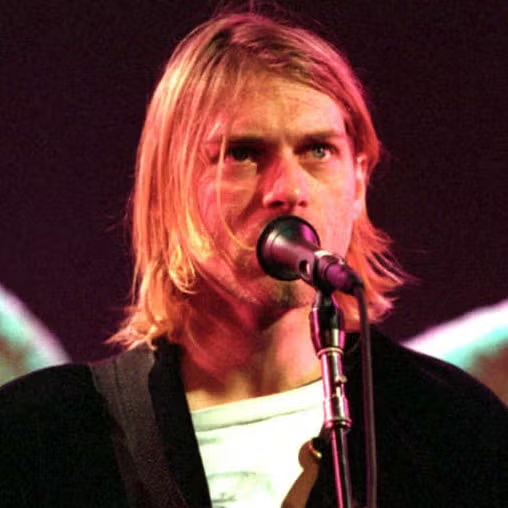

Kurt Cobain was the co-founder, lead vocalist, guitarist, and primary songwriter of Nirvana — the band whose 1991 album “Nevermind” is one of the most consequential records in the history of rock music, a collection of songs that crossed over from the underground alternative scene into mass commercial success with such force that it effectively ended one era of popular music and began another. Cobain himself became, against his expressed wishes and to his evident suffering, one of the most visible and analyzed celebrities of the 1990s — a position he found fundamentally incompatible with the artistic values and personal disposition that had produced the music that put him there.
Kurt Cobain Biography
| Full Name | Kurt Donald Cobain |
|---|---|
| Date of Birth | February 20, 1967 |
| Nationality | American |
| Occupation | Musician, Songwriter, Artist |
| Wife | Courtney Love (married 1992) |
| Children | Frances Bean Cobain |
| Known For | Nirvana, “Nevermind,” “Smells Like Teen Spirit,” grunge movement, cultural influence |
Early Life and Aberdeen
Kurt Cobain was born on February 20, 1967, in Aberdeen, Washington — a small working-class logging town on the coast of Washington State whose economic decline and cultural isolation shaped his experience and his artistic sensibility in ways he acknowledged repeatedly. Aberdeen was not a place that produced many rock stars, and the disconnect between the ambition and sensitivity he displayed from childhood and the environment he inhabited gave him both the feeling of alienation that runs through his music and the genuine identification with outsiders, misfits, and marginalized people that distinguished his public persona from the posturing of most rock celebrity.
His parents divorced when he was eight years old — a rupture he described in numerous interviews as profoundly destabilizing, and whose emotional fallout is audible in the music he made for the rest of his life. He moved between various family members’ homes in the years following the divorce, eventually living at times in genuinely difficult circumstances. The experience of family dissolution and economic precariousness in a declining industrial town gave his understanding of unhappiness and alienation a material grounding that purely imaginative artists cannot access — he was not performing outsider status, he had lived it.
His interest in music developed in early adolescence — he played drums before switching to guitar, which he taught himself with the obsessive commitment that would characterize all of his creative work. He was drawn to punk rock, which offered both the musical intensity he sought and an anti-establishment values framework that felt authentic to his experience. The music of the Pixies — with its quiet-loud dynamic that Cobain later acknowledged as central to his own compositional approach — the Melvins, and various underground bands that barely reached Aberdeen through cassette tapes and word of mouth formed the musical vocabulary from which Nirvana would eventually build.
Nirvana: Formation and Early Career
Cobain formed Nirvana in Aberdeen in 1987 with bassist Krist Novoselic. The band went through several drummers before Dave Grohl joined in 1990, completing the lineup that would achieve global success. Their early recordings on the Seattle-based Sub Pop Records — particularly the album “Bleach” (1989) — established them as a significant act in the Pacific Northwest underground scene that was developing around what would become known as grunge: a fusion of punk aggression, heavy metal dynamics, and alternative rock’s melodic and lyrical sensibility.
The band signed to DGC Records, a major label, and recorded “Nevermind” — released in September 1991. The album’s lead single, “Smells Like Teen Spirit,” received significant MTV airplay and the album rapidly crossed from alternative into mainstream commercial territory at a speed and scale that almost no rock record had achieved in years. By early 1992, “Nevermind” had displaced Michael Jackson’s “Dangerous” from the number one position on the Billboard 200 — a displacement that felt symbolic of a genuine shift in American popular music.
“Nevermind” and Cultural Impact
The cultural impact of “Nevermind” cannot be overstated, though it is frequently overstated in ways that Cobain himself would have found irritating. The album did not create grunge — that scene had been developing in Seattle and the Pacific Northwest for years. What “Nevermind” did was make a specific set of sounds, values, and attitudes commercially dominant in a way that repositioned the entire American music industry. Labels rushed to sign alternative bands; radio formats changed; MTV’s programming shifted; the flannel and distorted guitar sounds of the Pacific Northwest underground became the dominant signifiers of a particular kind of authenticity in mainstream youth culture.
Cobain found the celebrity that accompanied this success deeply uncomfortable — he was genuinely not oriented toward stardom and genuinely did not want what fame required. His discomfort with being the “voice of a generation” — a label journalists applied to him and that he rejected — was not false modesty but genuine incompatibility between the person he was and the role he was being assigned. The tension between the intimacy of his creative vision and the mass consumption of its products was one of the central difficulties of his final years.
The follow-up album “In Utero” (1993) — recorded with Steve Albini and deliberately abrasive in its production — was in part Cobain’s response to the commercial success of “Nevermind”: a record that forced its listeners to choose engagement over background consumption. It was a commercially successful record by most artists’ standards and a defiant one by Cobain’s.
Personal Life, Marriage, and Struggles
Cobain married Courtney Love, the lead singer of the band Hole, in February 1992. Their relationship — intense, mutually admiring, publicly turbulent — was one of the most analyzed in 1990s popular culture. Their daughter, Frances Bean Cobain, was born in August 1992. Cobain struggled throughout his public career with chronic stomach pain whose cause was never definitively diagnosed, and with heroin addiction — the latter widely covered in the press in ways that he found invasive and reductive.
He was genuinely compassionate and genuinely funny — qualities visible in interviews from the period — and he was also genuinely suffering in ways that went beyond his documented physical ailments. The combination of chronic pain, addiction, the demands of celebrity, the exhaustion of touring, and the difficulty of maintaining creative vision under commercial pressure created conditions that those around him recognized as dangerous.
Legacy
Cobain’s cultural legacy extends far beyond Nirvana’s three studio albums and into questions about creativity, mental health, commercial success, and the relationship between artistic authenticity and mass consumption that his career made dramatically visible. Frances Bean Cobain has grown into an artist in her own right. Dave Grohl’s subsequent work with Foo Fighters became one of the most commercially successful rock careers of the 1990s and 2000s, extending the impact of the Nirvana moment. The music itself — “Come as You Are,” “In Bloom,” “Heart-Shaped Box,” “All Apologies,” and dozens of others — endures with unusual force for recordings made more than three decades ago.
Conclusion
Kurt Cobain made music of genuine, lasting power from a specific time and place and set of personal circumstances, and the result was recordings that continue to connect with new generations of listeners who were not born when “Nevermind” was released. His refusal to manage his public image, his explicit discomfort with celebrity, and his commitment to artistic values that commercial success threatened to compromise gave his career a coherence and an integrity that most artists who achieve his level of fame do not maintain. The music made in Aberdeen, in Seattle, in recording studios across America in the early 1990s — by a man who genuinely did not want to be famous — remains some of the most significant rock music of the late 20th century.
Frequently Asked Questions
What is Nirvana’s most famous album?
“Nevermind” (1991), which crossed from the alternative underground into mainstream commercial dominance and is considered one of the most consequential rock albums ever made.
Who was in Nirvana?
Kurt Cobain (guitar, vocals), Krist Novoselic (bass), and Dave Grohl (drums) were the lineup on “Nevermind” and “In Utero.”
Who was Kurt Cobain married to?
Courtney Love, lead singer of Hole, whom he married in February 1992.
Does Kurt Cobain have children?
Yes — Frances Bean Cobain, born in August 1992, who has grown into an artist in her own right.
Where was Kurt Cobain from?
Aberdeen, Washington — a small working-class logging town on the coast of Washington State.
Editorial Notice
The biography above is compiled from publicly available sources and is intended for general informational purposes only. At PeopleCabal, we are committed to accuracy — however, public records evolve, and some details may change over time. If you notice anything that requires a correction or update, we welcome you to reach out to us directly.
