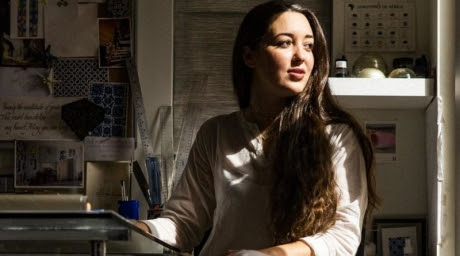

Dana Awartani is a Saudi Arabian visual artist whose work occupies a distinctive and increasingly influential space in the international contemporary art world — one rooted in the revival and reinvention of traditional Islamic geometric art, craft techniques, and calligraphy, executed through sustained studio practice and deep engagement with historical sources.
At a moment when questions of cultural heritage, globalization, and artistic identity are particularly charged, her commitment to mastering and evolving specifically Islamic visual traditions — rather than adopting Western contemporary art frameworks wholesale — represents both an artistic choice and a cultural position of genuine significance.
Dana Awartani Biography
| Full Name | Dana Awartani |
|---|---|
| Nationality | Saudi Arabian (Palestinian family heritage) |
| Occupation | Visual Artist |
| Education | Rhode Island School of Design (RISD); Prince’s School of Traditional Arts, London |
| Known For | Contemporary Islamic geometric art; traditional craft revival; international museum exhibitions |
Early Life and Background
Dana Awartani was born into a family with deep cultural roots — her family is of Palestinian heritage, and she grew up in Saudi Arabia with a strong sense of connection to Arab cultural and artistic traditions. She was drawn to art from a young age, and her eventual academic path took her to one of the world’s most prestigious art schools and then to a highly specialized institution focused specifically on the traditions she wanted to master.
She attended the Rhode Island School of Design (RISD) — consistently ranked among the top art schools in the world — for her foundational fine arts training. RISD’s rigorous curriculum gave her the technical and conceptual foundation of a contemporary art education while leaving open the question of what specific artistic language she would ultimately develop. The answer emerged when she subsequently attended the Prince’s School of Traditional Arts in London — an institution dedicated to the preservation and revival of traditional art forms from multiple cultures — where she immersed herself in the study of Islamic geometric patterns, calligraphy, and the mathematical and philosophical traditions underlying these art forms.
This dual education — contemporary at RISD, traditional at the Prince’s School — is central to understanding Awartani’s practice. She is not an untrained folk artist working in isolation from art world discourse, nor is she a Western-trained contemporary artist who has bolted Islamic imagery onto a conventional conceptual art framework. She is, unusually, genuinely trained in both traditions and uses her work to put them into productive dialogue.
Artistic Practice and Philosophy
Awartani’s work engages with the mathematical and cosmological dimensions of Islamic geometric art — patterns built on precise geometric relationships that were understood in classical Islamic culture as reflections of divine order and universal truth. These are not simply decorative traditions; they are a visual philosophy. The grid systems, the ratio relationships, the repetition and variation within strict constraints — all of these elements carry intellectual and spiritual content that Awartani takes seriously and attempts to communicate to contemporary audiences who may encounter Islamic art primarily through museum glass without understanding what they are looking at.
She works across multiple media — embroidery, natural dyes on silk, installation, and works on paper — often choosing materials and techniques that are themselves historically embedded in the traditions she is exploring. This commitment to material authenticity is not simply romantic nostalgia; it is the recognition that traditional techniques carry knowledge that cannot be fully transmitted through observation or description alone, and that working with those materials is itself a form of research.
Her installations have addressed political and cultural themes alongside the formal dimensions of her practice. Works addressing the destruction of cultural heritage sites — including ancient monuments in Syria, Iraq, and Palestine — have brought the ethical and emotional weight of cultural loss into the formal language of geometric beauty, creating a productive and sometimes painful tension that gives her work a gravity beyond pure aesthetic achievement.
International Exhibition Career
Awartani’s work has been exhibited at major international institutions and events including the Venice Biennale, the Sharjah Biennial, Art Dubai, and numerous galleries and museums across Europe, the Middle East, and the United States. Her participation in the Venice Biennale — the art world’s most prestigious exhibition — placed her work in conversation with contemporary artists from across the globe and confirmed her position as one of the more significant voices to emerge from the Arab world’s contemporary art scene in recent years.
She is represented by galleries in Dubai and London, giving her access to both the rapidly developing art market of the Gulf and the established infrastructure of the European contemporary art world. This dual presence reflects both the genuinely international character of her work and the equally international art market within which contemporary Arab artists increasingly operate.
Cultural Significance
The significance of Awartani’s work extends beyond its aesthetic qualities to its cultural and political dimensions. In an era when Islamic artistic traditions are frequently misrepresented, instrumentalized, or simply ignored in global art conversations, her insistence on taking those traditions seriously — on mastering their formal grammar, understanding their historical context, and developing them rather than simply referencing them — is an act of cultural advocacy as well as artistic practice. She is making visible a body of knowledge and a visual language that has global historical significance but remains undervalued in the contemporary art world’s hierarchies.
Personal Life
Awartani keeps her personal life largely private and presents herself primarily through her art and its associated ideas rather than through biographical disclosure. She is based between Saudi Arabia and the United Kingdom, which reflects both her family roots and her international professional networks.
Conclusion
Dana Awartani has positioned herself at an intersection that very few artists occupy with her degree of genuine preparation: between the contemporary art world and the deep tradition of Islamic geometric art, between the Gulf’s rapidly developing art infrastructure and the established institutions of Europe and America, between formal mastery and urgent political and cultural content. Her work does not seek to choose between these poles but to inhabit all of them simultaneously, and the result is a body of art that earns its place on the international stage through genuine substance.
Frequently Asked Questions
What type of art does Dana Awartani make?
She works in Islamic geometric art, calligraphy, embroidery, natural dye installations, and works on paper, engaging with the mathematical and cosmological traditions of classical Islamic visual culture.
Where did Dana Awartani study?
Rhode Island School of Design (RISD) for contemporary fine arts training, and the Prince’s School of Traditional Arts in London for specialized study of Islamic geometric traditions.
What major exhibitions has Dana Awartani participated in?
The Venice Biennale, Sharjah Biennial, Art Dubai, and exhibitions at major galleries and museums across Europe, the Middle East, and the United States.
What cultural themes does Dana Awartani’s work address?
Beyond the formal dimensions of Islamic geometric art, her work addresses cultural heritage destruction, political loss, and the value of traditional knowledge in the contemporary world.
What is Dana Awartani’s nationality and heritage?
She is Saudi Arabian, with Palestinian family heritage.
Editorial Notice
The biography above is compiled from publicly available sources and is intended for general informational purposes only. At PeopleCabal, we are committed to accuracy — however, public records evolve, and some details may change over time. If you notice anything that requires a correction or update, we welcome you to reach out to us directly.
