
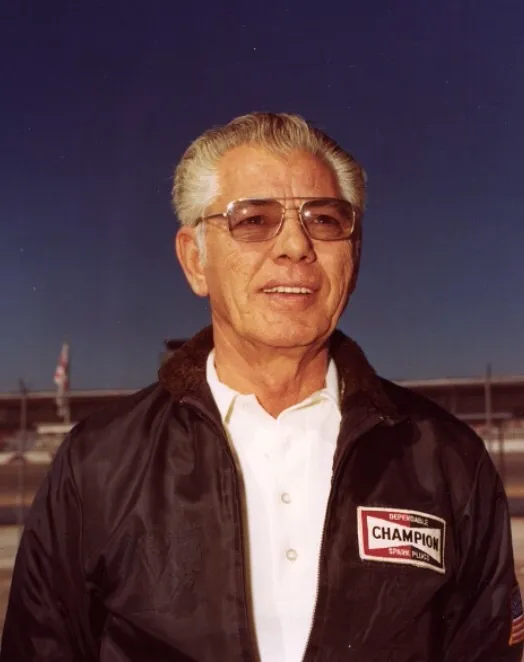

Fred Agabashian was one of the most respected figures in American motorsport during the post-World War II era, a racer whose gift for understanding what a car needed was so exceptional that his peers nicknamed him “Doc.” In a sport defined by speed and nerve, Agabashian brought something additional: an analytical intelligence that made him one of the most sought-after test drivers and setup specialists of his generation. His 1952 pole position at the Indianapolis 500, achieved in a revolutionary diesel-powered car, remains one of the most remarkable qualifying runs in the race’s long history.
Fred Agabashian Biography
| Full Name | Frederik Levon Agabashian |
|---|---|
| Date of Birth | August 21, 1913 |
| Place of Birth | Modesto, California, USA |
| Ethnicity | Armenian-American |
| Nationality | American |
| Profession | Racing Driver, Broadcaster |
| Siblings | Three sisters (including singer Alice Agabashian) |
| Known For | 1952 Indianapolis 500 pole position (Cummins Diesel Special), 11 Indy 500 starts |
Early Life and Background
Fred Agabashian was born on August 21, 1913, in Modesto, California, the son of Armenian immigrant parents. Fred and his three sisters grew up with what those who knew them described as a compulsive desire to succeed. While his sisters pursued music, with sister Alice building a notable career in radio and lounge singing in San Francisco and Reno, Fred chose racing.
He began racing roadsters as a teenager in the early 1930s. At 17, he won the Northern California Roadster Championship despite a serious accident at San Jose that injured him significantly. Surviving it reinforced his commitment to the sport.
Career Journey
Agabashian built his reputation first in midget car racing. He won the 1937 Northern California Racing Association championship and dominated the Bay Cities Racing Association after the war, winning championships in 1946, 1947, and 1948. In 1949, he won the 100-mile AAA National Championship race at Sacramento.
His first Indianapolis 500 appearance came in 1947, finishing ninth. He would go on to start eleven consecutive editions between 1947 and 1957. His best finish was fourth in 1953. The defining moment of his Indy career came in 1952, when the Cummins Engine Company developed a diesel-powered car with what was the first turbocharger in Indy 500 history. Agabashian drove it to pole position with a qualifying speed of 138.010 mph. Mechanical problems ended the race after 71 laps, but the pole run secured his place in Indy history. He started from the front row five times.
Later Career and Legacy
After failing to qualify for the 1958 Indianapolis 500, Agabashian retired from racing. He then joined Champion Spark Plug as a spokesperson and served as colour analyst on the Indianapolis Motor Speedway’s radio broadcasts from 1959 to 1965 and from 1973 onward. His articulate manner and deep knowledge of the race made him one of the most respected voices in the broadcast booth. He has been inducted into multiple racing halls of fame.
Frequently Asked Questions
What was Fred Agabashian’s nickname? “Doc,” for his extraordinary ability to diagnose mechanical issues with race cars.
What is Fred Agabashian most famous for? His 1952 Indianapolis 500 pole position in the Cummins Diesel Special, the first turbocharged car in Indy 500 history.
What was his ethnicity? He was of Armenian descent, born to Armenian immigrant parents in Modesto, California.
How many Indy 500s did he compete in? Eleven starts between 1947 and 1957.
What did he do after racing? He joined Champion Spark Plug as a spokesperson and served as a broadcaster for Indianapolis 500 radio coverage.
Editorial Notice
The biography above is compiled from publicly available sources and is intended for general informational purposes only. At PeopleCabal, we are committed to accuracy — however, public records evolve, and some details may change over time. If you notice anything that requires a correction or update, we welcome you to reach out to us directly.
