
There is no comfortable word for what Jhamak Kumari Ghimire has accomplished. She was born with cerebral palsy, unable to walk, stand, speak clearly, or use her hands. She received no formal schooling. She grew up in a poor rural home in Nepal where, by her own account, relatives sometimes greeted her with blessings normally reserved for the dying. And yet today she is one of Nepal’s most celebrated writers — a Madan Puraskar laureate, a national columnist, and a figure whose story has inspired millions. To describe her as remarkable is to understate the matter significantly.
Jhamak Kumari Ghimire Biography
| Full Name | Jhamak Kumari Ghimire (झमक कुमारी घिमिरे) |
| Date of Birth | July 4, 1980 (21 Ashad 2037 B.S.) |
| Place of Birth | Kachide village, Dhankuta District, Nepal |
| Nationality | Nepali |
| Occupation | Writer, Columnist, Poet |
| Known For | Jiwan Kada Ki Phool (autobiography); Madan Puraskar award |
| Parents | Krishna Bahadur Ghimire (father); Asa Devi Ghimire (mother) |
| Siblings | Three younger sisters and a brother |
| Awards | Madan Puraskar (2010); Padmashree Sahitya Puraskar; Kabita Ram Bal Sahitya Prativa Puraskar (2015); Aswikrit Bichar Sahitya Puraskar (2016) |
Early Life: Against Every Odd
Jhamak Kumari Ghimire was born on July 4, 1980, the eldest of five children in a modest family in Kachide, a village in Dhankuta District of eastern Nepal. From birth, she faced the compounded hardships of disability, poverty, and deep social stigma. Cerebral palsy robbed her of motor control over her arms and legs, slurred her speech beyond easy comprehension, and made conventional movement impossible. In a rural Nepali village with limited understanding of disability, she was frequently viewed as a burden — an object of pity or worse.
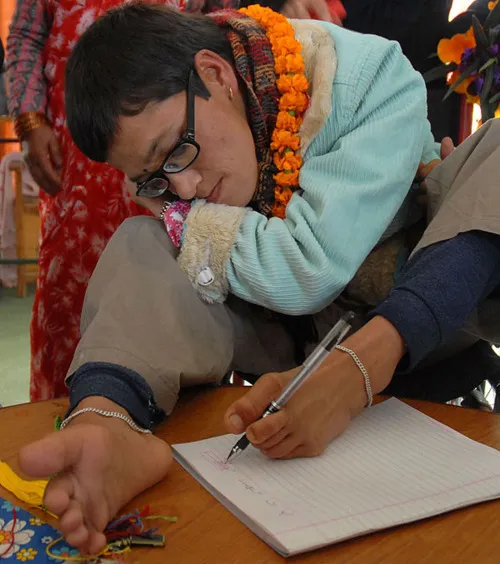
She was denied access to school. While her siblings attended classes, seven-year-old Jhamak sat at home and, with the three toes of her left foot, began drawing shapes in the mud. She watched her siblings read and write. She listened. She absorbed. And in doing so, she taught herself.
When she reached her late teens, this self-taught literacy found its full expression. At 19, she began writing poems, essays, and stories — using only the toes of her left foot — describing the social realities around her with unflinching honesty and considerable literary skill.
Literary Career
Ghimire’s most celebrated work is Jiwan Kada Ki Phool (literally “Is Life a Thorn or Flower?” — translated into English as “A Flower in the Midst of Thorns”), her autobiography published in 2010. The book, written entirely with her left foot, describes her life story with raw, unsparing detail — the rejection, the isolation, the slow emergence of her voice, and the joy of creation. It was reprinted seven times within two years, making it arguably the best-selling Nepali-language book of its era. It won the Madan Puraskar, Nepal’s most prestigious literary award.
She has also published several other books, including Sankalpa (Vow), Aafnai Chita Agni Shikhatira, and Manchhe Bhitraka Yoddhaharu (Warriors Inside Humans). She serves as a regular columnist for the Kantipur daily, one of Nepal’s most widely read newspapers, producing work that continues to comment on society, disability, and human resilience.
Scholars of world literature have noted that Ghimire is one of the most gifted writers living with cerebral palsy anywhere in the world — a recognition that extends well beyond Nepal’s borders.
Recognition and Impact
Beyond the Madan Puraskar, Ghimire has received the Padmashree Sahitya Puraskar, the Kabita Ram Bal Sahitya Prativa Puraskar (2015), and the Aswikrit Bichar Sahitya Puraskar (2016), among numerous other honors. The city of Dhankuta has placed welcome boards celebrating her in prominent locations, and a literary festival is organized every three years to mark her birth anniversary.
Her story has been discussed at international forums including Liverpool John Moores University, and her autobiography has been translated for readers outside Nepal. For millions of Nepali people — able-bodied and disabled alike — she stands as proof that the human will to express cannot be contained by physical limitation.
Personal Life
Jhamak remains closely connected to her family, including her parents and siblings, who were central to her story. Despite the difficult early years, she has spoken in interviews about her gratitude for the life she now leads and the community of readers and colleagues she has built. She has not publicly disclosed details about a romantic partner or spouse.
Net Worth
Jhamak Kumari Ghimire’s financial situation is not publicly detailed. Her income is derived from her writing, her column at Kantipur, and awards. Given Nepal’s literary economy, her wealth is likely modest, though her cultural and social capital within the country is immeasurable.
Conclusion
Jhamak Kumari Ghimire’s story refuses easy summary. It is not simply an “inspiration story” about overcoming disability, because that framing would flatten the genuine literary achievement involved. She is a skilled, original writer who happens to write with her foot — and whose insights about human nature, social injustice, and the will to create are worth reading on their own terms. Nepal is fortunate to have her voice.
Frequently Asked Questions
Q: How does Jhamak Kumari Ghimire write?
A: She writes using the three toes of her left foot, having taught herself literacy by watching her siblings and practicing independently from childhood.
Q: What is Jhamak Kumari Ghimire’s most famous book?
A: Jiwan Kada Ki Phool (Is Life a Thorn or Flower?), her autobiography published in 2010, which won the Madan Puraskar and became a Nepali bestseller.
Q: What award did she win?
A: She won the Madan Puraskar in 2010 — Nepal’s most prestigious literary award — for her autobiography.
Q: Where was Jhamak Kumari Ghimire born?
A: In Kachide village, Dhankuta District, eastern Nepal, on July 4, 1980.
Q: Does she have a formal education?
A: No. She was denied schooling due to her disability and taught herself to read and write by observing her siblings.
Editorial Notice
The biography above is compiled from publicly available sources and is intended for general informational purposes only. At PeopleCabal, we are committed to accuracy — however, public records evolve, and some details may change over time. If you notice anything that requires a correction or update, we welcome you to reach out to us directly.
